





Longevity has become a loud word. It sells devices, protocols, injections and subscription panels of blood markers. Most of it points somewhere exotic. Almost none of it points at the thing that actually fills your days, which is breakfast, and then lunch, and then dinner, and then breakfast again tomorrow.
Human Renaissance exists because of an unglamorous idea. Whatever longevity turns out to be, it is built out of repetition. Not one heroic decision, but a few thousand small ones that look identical from the outside. This article is the anchor for everything else we write, and it lays out the honest version of the argument, including the parts that get exaggerated elsewhere.
What does longevity actually mean?
In research, longevity usually means one of two things. Lifespan is how many years a person lives. Healthspan is how many of those years are lived in good function, without significant limitation. The two are not the same, and the gap between them is where most of the interesting work sits. Living longer is not the goal that most people are really describing when they say they care about longevity. They are describing wanting the last stretch of life to still feel like life.
One correction worth making early, because it circulates constantly online. People in the past did not live longer than we do. Historical life expectancy was substantially lower than it is today, largely because of infant mortality, infectious disease and injury. Modern medicine, sanitation and public health are the single biggest reason people now reach old age at all. Anyone selling you a story in which the past was a golden age of health is selling you something.
What is true, and far more interesting, is that many traditional food cultures ate in ways that were remarkably nutrient dense compared with a modern industrial diet. That is a claim about food quality, not about lifespan, and it holds up.
What longevity research keeps coming back to
Read across the literature on population health and ageing and the same themes surface again and again, in different regions and different study designs.
Dan Buettner and Sam Skemp described five regions with unusually high concentrations of people living past one hundred in Blue Zones: Lessons From the World's Longest Lived (American Journal of Lifestyle Medicine, 2016). The dietary common denominators were not supplements or extremes. They were whole plant foods, legumes, minimally processed staples and a relationship with food that was routine rather than occasional.
Bradley Willcox and colleagues have spent decades on the Okinawa Centenarian Study, and their paper Healthy aging diets other than the Mediterranean: a focus on the Okinawan diet (Mechanisms of Ageing and Development, 2014) characterises the traditional Okinawan pattern as low in calories yet high in nutrient density and antioxidant rich plant compounds. The phrase that matters there is nutrient density. Not more food. Better food, per bite.
Lars Fadnes and colleagues published Estimating impact of food choices on life expectancy: a modeling study (PLOS Medicine, 2022), which built a model from existing meta analyses and Global Burden of Disease data. It is a modelling study, not a guarantee for any individual, and the authors are clear about that. What it examines is how sustained shifts toward legumes, whole grains, nuts and away from processed meat associate with population level life expectancy estimates. The headline finding, that the modelled effect is largest when changes start earlier and continue, is really a finding about duration.
That is the thread. Almost every serious dietary finding in this field is a finding about something maintained over years, not something taken once.
Why daily repetition is the mechanism, not the marketing
Here is the uncomfortable arithmetic. A perfect week of eating is roughly 0.4 percent of a five year window. It is statistically invisible. The only nutrition that can plausibly matter over the timeframes longevity research operates on is nutrition you actually keep doing.
Behavioural research says the same thing from the other direction. Phillippa Lally and colleagues, in How are habits formed: modelling habit formation in the real world (European Journal of Social Psychology, 2010), tracked people adopting a daily eating, drinking or activity behaviour. Automaticity rose along a curve, and the average time to reach it was 66 days, with enormous individual variation, from 18 days to a projected 254. The practical reading is not the number. It is that consistency is a skill with a ramp, and most people quit inside the ramp.
This is why we are more interested in whether something is easy to repeat than whether it is impressive on paper. A nutritional food you drink in ten seconds every morning has a very different completion rate than a regimen of nine bottles. We wrote about that specific problem in the morning habit.
What traditional food cultures actually got right
Strip away the mythology and traditional diets share a few unglamorous properties. Food arrived whole, so nutrients came bundled with the fibre, fats and plant compounds they naturally grow alongside. Variety came from what the land produced, not from a shelf of separate products. And the foods that survived in harsh places tended to be the ones that had to defend themselves, which is often why they are dense in protective plant compounds.
That last point is where sea buckthorn enters the story. We go into it properly in whole food versus isolated nutrients, and into the sourcing side in where sea buckthorn grows.
Where sea buckthorn fits, and what is genuinely documented
Sea buckthorn, Hippophae rhamnoides, has a long and genuinely documented record of traditional use across Tibetan, Mongolian, Chinese and Russian practice. This is not a marketing origin story. It is written down.
A 2026 review in Frontiers in Pharmacology, Ethnopharmacology, phytochemistry, and pharmacology of sea buckthorn (Hippophae rhamnoides L.): a comprehensive review, traces its appearance in classical texts including the Tibetan rGyud bzhi (the Four Medical Tantras), the Mongolian pharmacological compendium known as the White Crystal Beads, and Li Shizhen's Bencao Gangmu. Beata Olas covered the composition side in The beneficial health aspects of sea buckthorn oil (Journal of Ethnopharmacology, 2018), which surveys its phenolic compounds, vitamins, unsaturated fatty acids and phytosterols.
We should be precise about what that means and what it does not. Documented traditional use tells you a plant was valued, used and recorded across centuries and cultures. It is a reason to look closely. It is not a clinical outcome, and we do not present it as one. Sea buckthorn has accumulated more than 1,200 published studies, which is a statement about research volume and nothing more. You can read what those investigations actually examine on our research page.
What we can state plainly is what is in the pouch, because it is label verified. Our wild sea buckthorn purée carries more than 190 naturally occurring compounds, every omega, 3, 6, 7 and 9, and 201 mg of vitamin C per 30 mL serving, which is 223 percent of the nutrient reference value. It contains 0 g of sugar. One ingredient, cold pressed with pulp, seed and oil intact. The full breakdown lives on what is inside.
Two of those deserve their own explanation. Omega-7 is the one almost nobody has heard of, covered in omega-7, and compared against the more familiar marine option in sea buckthorn versus fish oil. And vitamin C is unusual in a way most people never learn. Humans cannot make it. Guy Drouin and colleagues explained the genetics in The genetics of vitamin C loss in vertebrates (Current Genomics, 2011): a broken L gulonolactone oxidase gene, shared across anthropoid primates. Every milligram you have ever had came from food. We wrote that one up as the vitamin C your body cannot make.
Form matters too, which is a structural point rather than a physiological claim. A purée arrives already as food. A capsule has to be a capsule first. That distinction is the subject of absorption.
Food and medicine are not in competition
This needs saying without hedging, because the wellness industry has spent a decade blurring it. Nutrition is not a substitute for medical care. If you have a diagnosed condition, are on medication, are pregnant, or are managing anything at all with a clinician, keep doing that, and talk to them before adding anything new to your routine.
Food is what you do on the ordinary days. Medicine is what you have when you need it. Anyone framing those as rivals is asking you to make a trade that does not exist, and usually has something to sell on one side of it.
The consistency problem, and the app we built for it
The hardest part of daily nutrition is not choosing it. It is day 23, when nothing perceptible has happened and the novelty is gone.
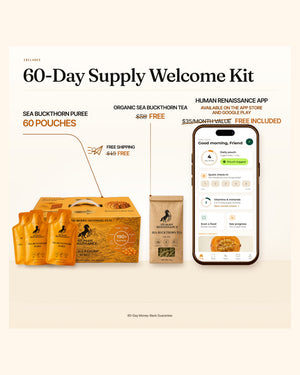
The Human Renaissance companion app exists for exactly that stretch. It does three plain things. It tracks your pouches so you can see the routine as an actual record rather than a vague sense of how you have been doing. It keeps a streak, because the ramp described in the habit research is real and a visible count is the cheapest way through it. And it scans labels, so when you are standing in an aisle you can read what is actually in something instead of the front of the box.
That is the whole pitch. It is a consistency tool. It does not measure your health, it does not promise you an outcome, and it will not tell you anything about your body. It tells you whether you did the thing. For a habit whose entire value is repetition, that turns out to be the useful number.
Frequently asked questions
Does sea buckthorn increase lifespan?
No, and we will not suggest otherwise. No food has been shown to extend an individual's lifespan, and any brand claiming that about a berry, a powder or a pill is making a claim it cannot support. What the research examines is nutrient composition and dietary patterns at a population level. Our purée is a nutrient dense whole food, not a longevity treatment.
Did people in the past really live longer?
No. Historical life expectancy was considerably lower than today's, primarily because of infant mortality and infectious disease. What is accurate is that many traditional diets were more nutrient dense and less processed than a typical modern one. That is a food quality observation, not a lifespan one.
Is a whole food better than a supplement for daily nutrition?
It depends on what you are after. Isolated compounds exist for a reason and are the right answer in specific, clinician guided situations. Our position is a preference, not a verdict: nutrients in a food arrive with everything they naturally grew alongside, and we would rather keep the berry whole than take it apart. That reasoning is set out in whole food versus isolated nutrients.
How long before I notice anything?
Honestly, this varies a great deal, and some people notice nothing they can point to. We would rather set that expectation than manufacture one. The reason we emphasise consistency is that a daily food is worth judging over months of routine, not over a first week.
Can I take this alongside my medication?
Ask your doctor or pharmacist first. That is the correct answer for any new addition to your routine, and it is not a formality. Food and medical care work together, and your clinician has context we do not.
The short version
Longevity is not a purchase. It is an accumulation. The research keeps returning to food quality, nutrient density and, above all, duration. Traditional food cultures ate remarkably well by that standard, and sea buckthorn is one of the plants that record kept. What we sell is one wild berry, cold pressed whole, in a form designed to be easy enough that you actually keep going.
See the purée, or read what is inside it first.
This article is general nutritional information and is not medical advice. It is not intended to diagnose, treat, cure or prevent any disease. Speak with a qualified healthcare professional about your individual circumstances.


