





Sea buckthorn vs fish oil is a comparison people usually get wrong in the first sentence, because they assume the two are competing for the same job. They are not. Fish oil exists to deliver two specific long-chain omega-3 fatty acids. Sea buckthorn is a whole fruit that happens to carry four omega families at once, including one that fish oil is not sold for at all.
Here is the straight version, including the parts that do not favour us.
The short answer
Fish oil is the better and essentially the only meaningful dietary supplement source of EPA and DHA, the long-chain omega-3 fats found in marine life. Sea buckthorn does not contain EPA or DHA in any meaningful amount, and we are not going to pretend otherwise.
Sea buckthorn is a source of omega-7, or palmitoleic acid, which fish oil is not marketed for, plus plant omega-3 as alpha-linolenic acid, omega-6 as linoleic acid, and omega-9. It also arrives as a whole food carrying vitamin C, vitamin E, carotenoids and flavonoids, which a refined oil capsule does not.
They are different tools. The interesting question is not which one wins. It is what each one actually is.
What is in fish oil
Fish oil is an extracted, refined marine oil. Its selling point is eicosapentaenoic acid and docosahexaenoic acid, usually abbreviated EPA and DHA. These are long-chain omega-3 fatty acids that the human body builds only inefficiently from plant omega-3, which is why marine sources matter nutritionally.
It is also, by construction, a fraction. The oil has been separated from the fish, refined, sometimes concentrated, often flavoured, and sealed in a softgel.
What is in sea buckthorn
Sea buckthorn, botanically Hippophae rhamnoides, is a berry, and its two oil fractions differ sharply. In a fatty acid analysis of Canadian-grown cultivars published in PLOS ONE in 2012, researchers reported that the pulp oil contained palmitoleic acid, omega-7, at 32 to 42 percent of total fatty acids, while the seed oil contained linoleic acid at 33 to 36 percent and alpha-linolenic acid at 30 to 36 percent, close to a one to one ratio of omega-6 to omega-3.
That is the whole reason sea buckthorn gets described as carrying omega 3, 6, 7 and 9 in a single fruit. It is not marketing language, it is what the chromatography shows, and it only holds if the whole berry is used rather than one pressed fraction.
The omega profiles side by side
- EPA and DHA (long-chain omega-3): fish oil yes, sea buckthorn no.
- Alpha-linolenic acid (plant omega-3): fish oil no, sea buckthorn yes, concentrated in the seed.
- Linoleic acid (omega-6): fish oil minimal, sea buckthorn yes, concentrated in the seed.
- Palmitoleic acid (omega-7): fish oil not a marketed source, sea buckthorn yes, concentrated in the pulp.
- Oleic acid (omega-9): present in both, more prominent in sea buckthorn pulp oil.
- Vitamin C, vitamin E, carotenoids, flavonoids: fish oil no, sea buckthorn yes.
If you want the deeper explanation of what omega-7 is and why it is the unusual one on that list, we wrote a full piece on omega-7 and palmitoleic acid.
Freshness is the difference nobody talks about
This is the practical difference between a highly unsaturated extracted oil and a fruit.
Long-chain omega-3 fats have many double bonds, and double bonds are where oxidation happens. Oxidised fish oil is a documented, measurable quality problem in the retail market, not a theory. In a multi-year analysis of 72 marine and microalgal omega-3 supplements sold in the United States, published in the Journal of Dietary Supplements in 2024, researchers found that 68 percent of flavoured and 13 percent of unflavoured products exceeded the total oxidation limit set by the Global Organization for EPA and DHA voluntary monograph standard.
Note what that study is and is not. It is a measurement of product freshness on shelves. It is not a claim about what oxidised oil does to anyone. We are citing it because it is the single most useful thing a shopper can know before comparing two categories: with a refined polyunsaturated oil, the freshness of the specific bottle in your hand is a real variable.
A purée made from a whole berry is a different physical situation. The fruit's own antioxidant compounds are still present, the fat has not been separated out and concentrated, and at Human Renaissance every pouch is sealed with the air pushed out so it does not slowly go stale before you drink it.
A capsule and a food are not the same delivery
A fish oil softgel is a measured dose of an isolated fraction. That is its design, and for EPA and DHA it is a sensible design.
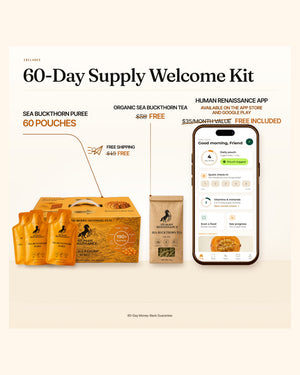
A purée is food. Ours is one ingredient, wild sea buckthorn, cold pressed with pulp, seed and oil intact, carrying more than 190 bioactive compounds, 201 mg of vitamin C per 30 mL serving at 223 percent of the nutrient reference value, and 0 g of sugar. Vitamin C contributes to normal collagen formation for the normal function of skin and to the normal function of the immune system.
Turn any bottle around and read the label. If the ingredient list says anything other than the fruit, you are not buying the berry, you are buying a processed version of a fraction of it. The full breakdown of what stays in ours is on the what is inside page.
What the research on each one examines
Fish oil has the larger and older human evidence base by a wide margin. EPA and DHA have been studied in clinical trials for decades. That is simply true.
Sea buckthorn has a substantial and growing literature of its own. More than 1,200 publications on Hippophae rhamnoides are indexed on PubMed. Again, that number describes research volume, meaning how much scientific attention the plant has attracted. It does not describe proven outcomes and should never be read that way.
On the omega-7 side specifically, the most directly relevant human work is a randomized, double-blind, crossover, dose-escalation trial published in The Journal of Nutrition in 2020, in which sea buckthorn oil supplementation moderately raised circulating palmitoleic acid in metabolically healthy adults. The same authors reported no significant effects on glucose, insulin or serum lipids and noted the study was not powered to detect them. A 2022 review in Cells describes the human evidence on palmitoleic acid as still incomplete and at times contested.
So: fish oil is the more established category, sea buckthorn is the more chemically complete fruit, and neither of those sentences is a health claim. What we have read is collected on our research page.
Do you have to choose
No. Nothing about eating a berry rules out taking a marine omega-3, and nothing here is a reason to stop anything a healthcare professional has recommended to you. If EPA and DHA are what you are after, sea buckthorn is not the answer to that question.
What sea buckthorn answers is a different question: whether you would rather get a broad range of fats and plant compounds the way they grew, in a food, instead of assembling them from separate bottles.
Common questions
Does sea buckthorn contain EPA and DHA like fish oil?
No. EPA and DHA are long-chain marine omega-3 fatty acids. Sea buckthorn provides plant omega-3 as alpha-linolenic acid, along with omega-6, omega-7 and omega-9.
Does fish oil contain omega-7?
Only in small amounts, and it is not what fish oil is standardised or sold for. Sea buckthorn pulp oil and macadamia nuts are the best known dietary sources of omega-7.
Is sea buckthorn a replacement for fish oil?
It is not a like-for-like replacement, because it does not supply EPA and DHA. It is a different source with a broader spread of fatty acids and the vitamins, carotenoids and flavonoids that come with whole fruit.
Why does fish oil go rancid and sea buckthorn purée does not behave the same way?
Highly unsaturated extracted oils oxidise readily once separated and concentrated. Published market analysis has found a substantial share of retail omega-3 products exceeding voluntary industry oxidation limits. A whole-fruit purée keeps the fruit's own antioxidant compounds with the fat and is sealed with the air pushed out.
Which has more research behind it?
Fish oil, by volume and by age of the evidence base. Sea buckthorn has more than 1,200 publications indexed on PubMed and is an actively studied plant, but the human clinical literature is younger.
See the berry for yourself
If the whole-food side of this comparison is the one that interests you, start with our wild sea buckthorn purée. One ingredient, nothing added, nothing isolated. Read next: why longevity, the piece that lays out why we think about nutrition this way in the first place.
References
- Fatima T, Snyder CL, Schroeder WR, et al. Fatty acid composition of developing sea buckthorn (Hippophae rhamnoides L.) berry and the transcriptome of the mature seed. PLOS ONE, 2012;7(4):e34099. https://doi.org/10.1371/journal.pone.0034099
- Hands JM, Anderson ML, Cooperman T, Frame LA. A multi-year rancidity analysis of 72 marine and microalgal oil omega-3 supplements. Journal of Dietary Supplements, 2024;21(2):195-206. https://doi.org/10.1080/19390211.2023.2252064
- Huang NK, Matthan NR, Galluccio JM, Shi P, Lichtenstein AH, Mozaffarian D. Supplementation with seabuckthorn oil augmented in 16:1n-7t increases serum trans-palmitoleic acid in metabolically healthy adults: a randomized crossover dose-escalation study. The Journal of Nutrition, 2020;150(6):1388-1396. https://doi.org/10.1093/jn/nxaa060
- Bermúdez MA, Pereira L, Fraile C, Valerio L, Balboa MA, Balsinde J. Roles of palmitoleic acid and its positional isomers, hypogeic and sapienic acids, in inflammation, metabolic diseases and cancer. Cells, 2022;11(14):2146. https://doi.org/10.3390/cells11142146
This article is educational and is not medical advice. Human Renaissance sea buckthorn purée is a food. Nutrient values quoted are from the product label.


