Your supplements were assembled in a lab. This one grew on a mountain.

Wild-harvested above 3,000 metres (about 10,000 feet).

See what's inside

One ingredient. That's it.

Sea Buckthorn. Hippophaë rhamnoides.

The whole berry, cold-pressed into a pouch. Nothing added, nothing isolated. Just a berry.

  • One ingredient100% sea buckthorn, nothing else in the pouch.
  • Whole berry, not seed oilThe whole fruit, not a single isolated fraction.
  • Cold-pressed wholeSkin, flesh and all, pressed into a smooth purée.
  • Nothing to break downIt arrives as food, not a pill your body has to dissolve.
Human Renaissance pouch, one half showing the label, the other half showing the whole sea buckthorn berries inside Human Renaissance pouch, one half showing the label, the other half showing the pressed sea buckthorn purée inside
  • No synthetic vitaminsEvery nutrient is the one the berry grew, not a lab copy.
  • Wild-harvestedHand-picked at altitude, wild, never farmed.
  • Sealed airtightSealed the moment it is pressed, so it stays fresh.
  • One pouch a day30 mL, straight from the pouch. No mixing, no measuring.
No fillersNo flavoursNo sweetenersNo synthetic vitamins

The breakdown

More than 190 compounds. These eight do the heavy lifting.

One box is 60 pouches, 5,640 whole berries, 1,800 mL of pressed fruit. Here is what that carries, and what each part actually does.

Roughly 14,000 mg in a box.

Omega-7 is palmitoleic acid. It sits in the cells under your skin and in the lining of your gut, and it gets spent every time those surfaces repair themselves. Your body does not make it. In this berry it lives in the pulp oil, not the seed, so pressing the whole fruit is the only way to keep it. About 14,000 mg across a box, roughly 233 mg in each 30 mL pouch.

macadamia nuts
Almost nothing else carries it

Macadamia nuts are one of the very few foods with omega-7 in a real amount. Fish oil carries almost none. Outside those, a normal week of eating gives you close to nothing.

More than 18,000 mg in a box.

These are the fats your cell membranes are built from, and the ones your brain and skin keep drawing on. In sea buckthorn the omega-3 and omega-6 sit in the seed and the omega-9 sits in the pulp, which is exactly why we press the whole fruit instead of one part of it. Seed oil alone loses half the picture.

flaxseed
Normally three separate foods

Flax for omega-3, seed oils for omega-6, olive oil for omega-9. One fruit grows all three, in the ratio it grew them in.

12,060 mg in a box.

201 mg in every pouch, 223% of the daily reference value, 12,060 mg across the box. Vitamin C is the cofactor that locks collagen together. Without it the strands never set, and collagen is what holds skin, blood vessels and cartilage in shape. Your body cannot make it and cannot store much of it, so it has to arrive again every day.

oranges
Per 100 g, next to other fruit

Sea buckthorn runs about 400 to 600 mg per 100 g depending on the cultivar. Orange is about 53, strawberry 59, kiwi 93, blackcurrant 181. Two fruits do beat it, acerola and camu camu, and neither is one you eat by the handful. Among fruit you can actually eat daily, this is the top tier.

Both families, not one.

Vitamin E is not one molecule. It is two families, tocopherols and tocotrienols, and they sit in the fatty part of a cell where they stop oxidation from spreading along the membrane. Nuts and seeds give you the first family. Sea buckthorn carries both, dissolved in the berry's own oil, which is the form a fat-soluble vitamin has to be in to be absorbed at all.

almonds
Honest about the ranking

Almonds, sunflower seeds and wheat germ hold more total vitamin E per 100 g than this berry does. Nearly all of it is tocopherol. It is the tocotrienol half that is genuinely hard to find in an ordinary diet.

Where light lands.

Carotenoids are the orange pigment, and they are how the plant survives the light at 3,000 metres. In your body they gather where light lands. Zeaxanthin and lutein are the only two carotenoids the eye pulls out of the blood and stacks in the retina, and sea buckthorn is among the richest fruit sources of them.

carrots
Carried in the berry's own oil

Carrots carry carotenoids too, and you absorb them far better with fat present. Here the fat and the pigment grew in the same fruit.

More than 14,400 mg of polyphenols in a box.

The berry's flavonoids, isorhamnetin and quercetin among them, arrive still attached to sugar, and very little of them crosses into the blood in that form. Most travel the whole length of your gut and reach the colon intact, where your own bacteria cut them open and work on what is inside. For this group the gut is not the passageway. It is the destination.

blueberries
Built under high-altitude UV

Blueberries are the flavonoid fruit everyone names. This one grows above 3,000 metres, where the light is harsher and the plant has to build more of its own defence to survive it.

More than 30,000 mg in a box.

Eighteen amino acids, including all nine your body cannot build for itself. Amino acids are the parts protein is assembled from, so they are the raw material behind skin, hair, muscle and every enzyme you run on. A complete set inside a single fruit is unusual.

pasture eggs
The profile you expect from eggs

Eggs are what people reach for when they want a complete amino acid profile. This is a berry that carries one.

Fourteen or more, in food form.

Iron, zinc and potassium among them. Minerals are what everything else on this list needs in order to work: most enzymes are a protein folded around a single metal atom, and without that atom the enzyme does nothing at all. Here they arrive with the vitamin C and organic acids the berry grew alongside them, which is the company they are meant to keep.

pumpkin seeds
Not a row of separate tablets

A handful of pumpkin seeds gives you a similar trace set. The difference is what they arrive with, not just what they are.

What's in a serving

Not a pill. Not a powder. A whole food.

Serving size: 30 mL Pouches per box: 60 1,800 mL per box 5,640 whole berries One a day
Per 30 mL pouch, from the nutrition label
Whole berries pressed in94
Energy19 kcal
Total fat0 g
Carbohydrate3.1 g
Added sugar0 g
Fibre0.36 g
Protein0.36 g
Vitamin C201 mg · 223% NRV
Flavonoids21.3 mg
Superoxide dismutase201 mg
One box · 60 pouches · 1,800 mL
Whole berries5,640
Vitamin C12,060 mg
Organic acids36,000 mg+
Amino acids30,000 mg+ · 18 types
Omega 3 · 6 · 918,000 mg+
Polyphenols14,400 mg+
Omega-714,000 mg+
Plant sterols3,600 mg+
Trace minerals14+
Vitamins17+, in whole-food form
Bioactive compounds190+
Human Renaissance Sea Buckthorn Purée pouch, 30 mL Human Renaissance Sea Buckthorn Purée box, 60 single-serve pouches

One whole berry, pressed. Here is what it gives you.

  • Omega-7, the rare one, about 233 mg a pouch, for your skin and the lining of your gut
  • Vitamin C, 201 mg at 223% NRV, which supports normal collagen formation and normal immune function
  • 190+ naturally occurring compounds that grew together in the berry, not blended from a list
  • One whole berry, pressed whole and sealed. Nothing added.

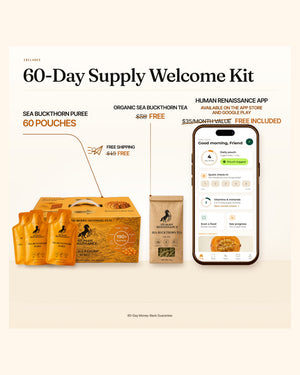
One box. Two months of one a day.

  • 60 single-serve pouches, 30 mL each
  • 1,800 mL of sea buckthorn purée in total
  • 5,640 whole berries, hand-picked
  • A two-month supply at one pouch a day

From branch to pouch

From wild berry to whole purée.

Hand-harvested. Flash-frozen. Cold-pulped whole.

Original field filmSea buckthorn landscape and harvest

Cut by hand.

Berry-laden branches are cut by hand where the plant grows.

That is how one wild berry stays one ingredient.

Human Renaissance, the shining horse

The shining horse

They named it for what it did to horses.

Alexander's worn-out horses, left behind on the march home, returned strong and glossy-coated from grazing the wild orange berry. Greek physicians named it Hippophaë, from híppos, horse, and pháos, to shine. The shining horse.

327 BCE Alexander's march

The cavalry ration that earned the berry its name.

1950s SOVIET The space program

Issued to early cosmonauts; worked into creams to shield skin in orbit.

2008 BEIJING The Olympic Games

An official nutritional source for Chinese Olympic athletes.

Today ON RECORD PubMed · 1,200+ studies

1,200+ studies now index the berry's 190+ compounds.

Twenty-three centuries of human use. One berry.

What it replaces

The spread you'd shop for. One berry grows it all.

Vitamins, omegas, carotenoids, flavonoids. To cover a range this wide from food alone, you would be shopping the produce aisle all week. Sea buckthorn grows the spectrum in one wild berry.

Every single day.
sirloin steaks
2 sirloin steaks
salmon fillets
3 salmon fillets
lamb chops
4 lamb chops
pork tenderloin
1 pork tenderloin
beef liver
2 oz beef liver
pasture eggs
6 pasture eggs
shrimp
12 shrimp
oysters
6 oysters
sardines
2 tins sardines
mackerel fillets
2 mackerel fillets
oranges
3 oranges
carrots
6 carrots
macadamia nuts
1 handful of macadamias
apricots
5 apricots
pomegranates
3 pomegranates
blueberries
7 blueberries
mangoes
2 mangoes
red peppers
3 red peppers
beets
4 beets
sweet potatoes
2 sweet potatoes
spinach
1 spinach
kale
1 kale
almonds
12 almonds
walnuts
3 walnuts
pumpkin seeds
2 tbsp pumpkin seeds
brazil nuts
2 brazil nuts
flaxseed
2 tbsp flaxseed
green tea
2 green tea
kiwis
2 kiwis
papaya
1 papaya
=
Or just
One Human Renaissance pouch
One pouch. 30 mL · cold-pressed · 30 sec
Harvesters hand-cutting sea buckthorn branches in a high-altitude mountain landscape
Hand-harvested where it growsTibetan Plateau and Inner Mongolia, cut by hand from wild stands.

What we will not compromise

Our standards begin before the pouch.

Protect the berry. Keep the whole fruit. Show the work. Leave nothing unnecessary in the pouch.

Harvested where it grows wild

Picked by hand on the Tibetan Plateau and in Inner Mongolia. You cannot greenhouse a mountain, so we follow the berry.

The whole fruit, nothing stripped out

Pulp, skin, seed and oil, cold-pulped together, never reduced to the one fraction that is easiest to bottle.

Nothing added to make it easier

No fillers, flavours, sweeteners or synthetic vitamins. If the berry did not grow it, it stays out.

Tested, then shown

Every batch is lab-tested for pesticides and herbicides, and we publish the report.

Why you've never heard of it

You can't patent a wild berry.

Companies fund what they can own. A molecule designed in a lab can be patented, priced and protected for twenty years. A berry that grows wild on mountainsides belongs to no one, so no one pays to put it in front of you.

That is the whole answer. No ad budget, no sponsored headlines, no sales rep with a quota. The research kept stacking up quietly while the marketing money followed the molecules with owners.

It isn't underrated by accident. It's underrated by design.

Wellness, in one berry

Taste the whole berry, intact.

One wild fruit, cold-pressed whole. Its full chemistry, in a form your body can actually use. Not a pill. Not an isolate. Food.

Two-month supply · one pouch a day Whole-food · nothing isolated or synthetic 60-day money-back guarantee
Start your renaissance
Human Renaissance Sea Buckthorn Purée pouch

Questions about what is inside.

The berry, the box and how we test it

When will I actually notice a difference?

Your body cannot store most of this. Vitamin C empties out daily. Omega-7 gets spent every time the surfaces that use it repair themselves. So the first two weeks are your body catching up on a shortfall it has been running for years, and that is usually the part people feel first, in the hour of the afternoon that normally goes flat. Weeks three to six are when the things you can see start to move, because skin and hair are built from what arrived weeks earlier, not this morning. By day 60 you have given your body a full cycle of raw material it was short on. It is food, not a drug. Results vary.

Why does it cost around $200?

One box is 60 pouches, a full two months. The berries grow wild at 3,000 metres and are picked by hand. We press the whole berry and seal each pouch airtight so it stays fresh. No fillers, no cheap oil to stretch it. You pay for the whole berry, nothing else.

Why not just buy a cheaper sea buckthorn supplement?

Turn the bottle around and read the label. Most are seed oil in a capsule, or purée cut with water and sugar. If the ingredient list says anything other than sea buckthorn, you are not buying the berry. Ours has one ingredient.

What if it doesn't do anything for me?

It does something for every body, because that is not a claim about you, it is what a body does with food. Vitamin C, omega-7, eighteen amino acids, fourteen minerals: these are not optional inputs your body might decide to use. They are the raw material it builds from, every single day, whether you are paying attention or not. More than 190 compounds arrive in every pouch and your body puts them to work the same way it puts a meal to work. What you notice, and how quickly, is the part that varies from person to person. That it is being used is not.