





Omega-7 is the least discussed of the four omegas. Most people can name omega-3. A few can name omega-6 and omega-9. Almost nobody can tell you what omega-7, also called palmitoleic acid, actually is or where it comes from. That is strange, because it is one of the very few fatty acids that appears in ordinary food in meaningful amounts from only a short list of sources. Sea buckthorn is one of the richest of them.
This is a plain explanation of what omega-7 is, which foods carry it, how much of it sits in a sea buckthorn berry, and what published research has and has not looked at. No promises. Just the chemistry, the food, and the state of the science.
What is omega-7?
Omega-7 is the common name for palmitoleic acid, written by chemists as 16:1n-7. Break that down and it tells you everything the name is hiding.
- 16 means the molecule is a chain of sixteen carbon atoms.
- 1 means it has one double bond, which makes it a monounsaturated fatty acid, the same broad family as the oleic acid in olive oil.
- n-7 means that double bond sits seven carbons in from the tail end of the chain. That single position is the whole reason it is called omega-7 rather than omega-9.
So omega-7 is not a vitamin, not a botanical extract, and not a proprietary compound. It is a specific monounsaturated fat, defined entirely by its shape.
Is omega-7 essential?
No, and this matters. Omega-3 and omega-6 are called essential fatty acids because the human body cannot build them and has to take them in from food. Omega-7 is different. Your body can make palmitoleic acid itself, converting palmitic acid using an enzyme called stearoyl-CoA desaturase-1. It is also found naturally in human tissue, which is why researchers describe it as endogenous rather than essential.
Anyone selling omega-7 as something you are deficient in is overstating the case. The honest framing is narrower and more interesting: omega-7 is a fat your body already recognises, and dietary sources of it are unusually rare.
Where omega-7 is found in food
Most everyday fats are dominated by oleic acid, linoleic acid, or palmitic acid. Palmitoleic acid usually shows up only in trace amounts. The short list of foods where it is a headline component includes:
- Sea buckthorn pulp oil. The single most concentrated plant source in common use.
- Macadamia nuts. The best known nut source.
- Some fish and marine oils, where it appears alongside the long-chain omega-3 fats but is not the reason anyone buys them.
- Dairy fat, which carries small amounts, including a naturally occurring trans form that nutrition researchers have studied separately.
That is close to the whole list. If you eat a normal diet without macadamias or sea buckthorn, your dietary intake of omega-7 is very small.
How much omega-7 is in sea buckthorn
This is where sea buckthorn stops being one berry among many. A berry has two distinct oil fractions, and they are not the same thing at all.
In a study of Canadian-grown sea buckthorn cultivars published in PLOS ONE in 2012, gas chromatography analysis found that the pulp oil contained palmitoleic acid at 32 to 42 percent of total fatty acids, while the seed oil was dominated instead by linoleic acid at 33 to 36 percent and alpha-linolenic acid at 30 to 36 percent, close to a one to one ratio of omega-6 to omega-3. Work on Himalayan-grown species published in the Journal of the American Oil Chemists' Society reported pulp oil palmitoleic values in a similar and sometimes higher band.
Two things follow from that, and both are worth sitting with.
First, sea buckthorn carries omega-3, omega-6, omega-7 and omega-9 in one fruit, which is genuinely uncommon. Second, the omega-7 lives in the pulp, not the seed. A product made only from pressed seed oil is a different product from one made from the whole berry. This is exactly why Human Renaissance presses the fruit whole, pulp, seed and oil together, rather than isolating a single fraction. You can see the full breakdown of what stays in the berry on our what is inside page.
What the research on palmitoleic acid actually examines
Search PubMed for Hippophae rhamnoides, the botanical name for sea buckthorn, and you will find more than 1,200 indexed publications. That is a real number and it is worth understanding correctly. It measures research volume, meaning how much scientific attention the plant has received. It is not a measure of proven outcomes, and no honest brand should present it as one.
Here is what the palmitoleic acid literature is actually doing.
Human studies
The most directly relevant human trial is a randomized, double-blind, crossover, dose-escalation study published in The Journal of Nutrition in 2020 by researchers at the Jean Mayer USDA Human Nutrition Research Center on Aging and Tufts University. Thirteen metabolically healthy adults took sea buckthorn oil at escalating doses. The researchers measured serum phospholipid fatty acids and found that supplementation moderately increased circulating palmitoleic acid in a dose-related way.
The authors were equally clear about the limits. They reported no significant effects on blood glucose, insulin, lipids, or other clinical measures, and explicitly noted the study was not designed or powered to detect such effects. They framed their own result as supporting further work rather than establishing a benefit. That is the honest read, and we are not going to dress it up as anything more.
Laboratory and animal studies
Most of what exists on palmitoleic acid is preclinical. A 2024 study in Molecular Nutrition and Food Research fed mice sea buckthorn pulp oil and examined effects on serum metabolites and gut microbiota. A 2013 study in Appetite examined how orally administered palmitoleic acid affected food intake and appetite-related hormones in rats.
Animal and cell work is how questions get generated. It is not how they get answered for humans, and the distance between a mouse fed pulp oil for sixteen weeks and a person drinking a pouch is not a distance any responsible reader should be asked to ignore.
What the field itself says about its own evidence
A 2022 review in Cells covering palmitoleic acid and its positional isomers put it directly: results have been diverse across cell lines, animal models and humans, numerous effects have been attributed to palmitoleic acid in mouse models and cell lines, and its role in humans is not fully understood and is sometimes controversial.
That is the accurate summary of omega-7 research as it stands. It is an active, well-funded, unresolved area. Anyone telling you it is settled is selling something. Our own reading of the literature is collected on the research page.
Omega-7 compared with omega-3, omega-6 and omega-9
The four omegas are grouped by one detail only: where the first double bond sits in the carbon chain. They are not four versions of the same thing.
- Omega-3 covers alpha-linolenic acid from plants and the longer-chain EPA and DHA found in marine sources. Alpha-linolenic acid is essential.
- Omega-6 covers linoleic acid, abundant in seed oils and also essential.
- Omega-7 is palmitoleic acid, not essential, rare in food.
- Omega-9 is mostly oleic acid, not essential, and abundant in olive oil.
The practical point is that omega-7 is not a substitute for omega-3 and omega-3 is not a substitute for omega-7. They are different molecules doing different structural work. If you want that comparison drawn out properly against the most common omega product on the shelf, read sea buckthorn versus fish oil.
Whole berry or isolated omega-7 oil
Most omega-7 on the market is sold as a softgel of concentrated oil, standardised to a palmitoleic acid percentage. That is one legitimate way to do it. It is not the only one.
The alternative is to leave the fatty acid where it grew, surrounded by everything else the fruit made alongside it. A sea buckthorn berry carries more than 190 bioactive compounds, including vitamin C, vitamin E in both tocopherol and tocotrienol forms, carotenoids and flavonoids. Our own pouch is one ingredient, cold pressed whole, with 201 mg of vitamin C per 30 mL serving at 223 percent of the nutrient reference value, and 0 g of sugar. Vitamin C contributes to normal collagen formation for the normal function of skin and to the normal function of the immune system.
Nature did not isolate the omega-7. We did not either. That is the entire argument, and it is a positioning argument about food, not a claim about outcomes. It is also the same reasoning behind everything else we build, which we lay out in full in why longevity.
Common questions about omega-7
What is omega-7?
Omega-7 is the common name for palmitoleic acid, a sixteen-carbon monounsaturated fatty acid with one double bond seven carbons from the end of the chain. It occurs naturally in human tissue and in a small number of foods.
Is omega-7 the same as palmitoleic acid?
Yes. Omega-7 is the everyday name and palmitoleic acid, or 16:1n-7, is the chemical name for the same molecule.
Which foods contain the most omega-7?
Sea buckthorn pulp oil and macadamia nuts are the two best known dietary sources. Published analysis of sea buckthorn cultivars has reported palmitoleic acid at 32 to 42 percent of the fatty acids in pulp oil.
Is omega-7 an essential fatty acid?
No. Unlike omega-3 and omega-6, the human body can produce palmitoleic acid on its own, so it is not classified as essential.
Is omega-7 found in the seed or the pulp of sea buckthorn?
The pulp. Sea buckthorn seed oil is dominated by linoleic acid and alpha-linolenic acid instead. This is why whole-berry products and seed-oil-only products are not interchangeable.
How much omega-7 research exists?
More than 1,200 publications on Hippophae rhamnoides are indexed on PubMed, and palmitoleic acid has its own separate and growing literature. Most of the mechanistic work is preclinical, and reviewers describe the human evidence as still developing.
Try the whole berry
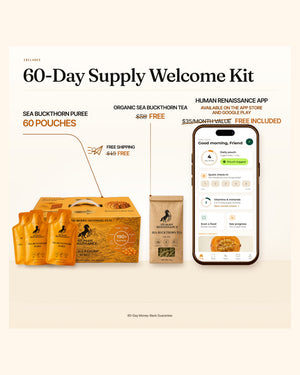
If you would rather take omega-7 the way it grew, in a fruit, alongside the other three omegas and everything else the berry made, start with our wild sea buckthorn purée. One ingredient, nothing added, nothing isolated.
References
- Fatima T, Snyder CL, Schroeder WR, et al. Fatty acid composition of developing sea buckthorn (Hippophae rhamnoides L.) berry and the transcriptome of the mature seed. PLOS ONE, 2012;7(4):e34099. https://doi.org/10.1371/journal.pone.0034099
- Huang NK, Matthan NR, Galluccio JM, Shi P, Lichtenstein AH, Mozaffarian D. Supplementation with seabuckthorn oil augmented in 16:1n-7t increases serum trans-palmitoleic acid in metabolically healthy adults: a randomized crossover dose-escalation study. The Journal of Nutrition, 2020;150(6):1388-1396. https://doi.org/10.1093/jn/nxaa060
- Bermúdez MA, Pereira L, Fraile C, Valerio L, Balboa MA, Balsinde J. Roles of palmitoleic acid and its positional isomers, hypogeic and sapienic acids, in inflammation, metabolic diseases and cancer. Cells, 2022;11(14):2146. https://doi.org/10.3390/cells11142146
- Zhang J, Zhao M, Yu H, et al. Palmitoleic acid ameliorates metabolic disorders and inflammation by modulating gut microbiota and serum metabolites. Molecular Nutrition and Food Research, 2024;68(7):e2300749. https://doi.org/10.1002/mnfr.202300749
- Yang ZH, Takeo J, Katayama M. Oral administration of omega-7 palmitoleic acid induces satiety and the release of appetite-related hormones in male rats. Appetite, 2013;65:1-7. https://doi.org/10.1016/j.appet.2013.01.009
- Fatty acids, tocols, and carotenoids in pulp oil of three sea buckthorn species (Hippophae rhamnoides, H. salicifolia, and H. tibetana) grown in the Indian Himalayas. Journal of the American Oil Chemists' Society, 2006;83:359-364. https://doi.org/10.1007/s11746-006-1213-z
This article is educational and is not medical advice. Human Renaissance sea buckthorn purée is a food. Nutrient values quoted are from the product label.


