

The comparison
Sea Buckthorn vs Acai: Two Famous Berries, Compared Honestly
Acai became famous and sea buckthorn did not, which explains the reputations and none of the composition.
What it is, and what it actually carries.
Held against it, point by point.
By Dr. Raj Dhadwal
Acai became famous. Sea buckthorn, also spelled seabuckthorn, did not. That is most of the difference in how the two berries are talked about, and almost none of the difference in what they actually are. One is an Amazonian palm fruit sold almost entirely as frozen pulp or powder. The other is a northern shrub berry sold as puree, juice or oil. They overlap less than the shared "superfruit" label suggests.
Acai's strength is its anthocyanin-rich raw pulp; sea buckthorn's is an unusual combination of high vitamin C, carotenoids, tocopherols and a pulp oil carrying omega 3, 6, 7 and 9, and both are usually judged on a retail form that is not the raw fruit.
What is acai?
Acai is the fruit of Euterpe oleracea, a palm that grows in the floodplain forests of the Amazon estuary, mostly in northern Brazil. The fruit is small, dark purple, and mostly seed. The edible part is a thin layer of pulp around a large stone, which is why acai yields so little usable material per kilogram of fruit and why it is never sold as whole fresh berries outside the region.
It has been a staple food in the Amazon estuary for a very long time, eaten as a thick unsweetened pulp, often alongside fish or cassava rather than as a sweet dish. The sweetened smoothie bowl is a much more recent export invention.
What is sea buckthorn?
Sea buckthorn is the fruit of Hippophae rhamnoides, a thorny shrub that grows in cold, high, exposed places. It is a small orange berry, intensely sour, and unlike acai it is almost entirely pulp with a small seed.
The plant is built for hardship. It fixes nitrogen, holds poor soil together, and survives conditions that kill most fruiting shrubs, which is why it is planted for land reclamation as often as for fruit. The best-known wild populations grow on the Tibetan Plateau, above 3,000 metres, about 10,000 feet, and in Inner Mongolia.
Where does each one grow?
| Factor | Acai | Sea buckthorn |
|---|---|---|
| Plant type | Tall palm, multi-stemmed | Thorny deciduous shrub |
| Climate | Hot, humid, tropical floodplain | Cold, dry, high altitude or coastal |
| Main growing regions | Amazon estuary, northern Brazil | Tibetan Plateau and Inner Mongolia for the wild fruit; cultivated across northern Europe and Canada |
| Harvest | Climbed by hand, bunches cut from the crown | Hand-picked or branch-cut; the thorns make it slow either way |
| Fruit structure | Large seed, thin pulp layer | Mostly pulp, small seed |
| Shelf life after picking | Very short; the pulp is commonly processed within 24 hours of harvest | Short; usually frozen or pressed quickly |
Both berries share a problem: they cannot travel as fresh fruit. That single fact shapes everything about how each one reaches you, and it is why comparing the two on raw-fruit composition alone tells you less than it appears to. For the sea buckthorn side of that story, see how sea buckthorn is harvested.
How is each one actually sold?
This is the part most comparisons skip, and it changes the answer more than the composition tables do.
Acai is sold almost exclusively as frozen pulp packs or as a spray-dried or freeze-dried powder. Frozen pulp is often blended with other juice or with sugar before it is packed, and a retail bowl adds more on top: banana, honey, granola, syrup. The bibliometric and technology review of acai in Foods describes the processing chain in detail, and a lot happens between the palm and the tub. Reading the ingredient panel on an acai product is not optional.
Sea buckthorn is sold as juice, as puree, as a dried powder, and as two different oils pressed from two different parts of the fruit. These are not interchangeable, and the differences are covered in pulp oil versus seed oil. Juice and concentrate discard pulp. Powder removes water and, with it, some of the fragile compounds. Whole puree keeps the pulp and the oil fraction together.
So you are almost never choosing between two berries. You are choosing between a sweetened frozen pulp blend and a pressed whole puree, or between two powders, and the processing decisions matter as much as the botany.
How do the two compare nutritionally?
Figures below describe the raw or minimally processed fruit, drawn from USDA FoodData Central, the Norwegian Food Composition Table and published composition reviews. Published ranges for both fruits are wide, so directions are given where a single number would be false precision.
| Nutrient class | Acai (raw pulp) | Sea buckthorn (raw berry) |
|---|---|---|
| Vitamin C | Low. Acai is not a notable vitamin C source and loses more in processing | High, and the standout figure. The Norwegian table publishes 131 mg per 100 g, and composition reviews report considerably higher figures for some subspecies |
| Anthocyanins | High. This is acai's signature compound class and the source of the deep purple colour | Low. Sea buckthorn is orange, not purple, and its flavonoid profile runs to flavonols rather than anthocyanins |
| Carotenoids | Present but modest | High. The Norwegian table publishes 860 micrograms of beta-carotene per 100 g, and the composition literature documents zeaxanthin as well. The orange colour suggests carotenoids; the analyses are what establish them |
| Tocopherols, vitamin E | Present in the fat fraction | High. The Norwegian table publishes 3.1 mg-ATE per 100 g, and reviews document tocotrienols alongside tocopherols |
| Fat fraction | Unusually high for a fruit, dominated by oleic acid, with palmitic and linoleic acid as the next largest fractions | Unusually high for a fruit, and unusual in kind: pulp oil carries palmitoleic acid, omega-7, alongside omega 3, 6 and 9 |
| Sugar | Low in the raw pulp; frequently high in the retail product because of what is added | Low in the raw berry, which is part of why it tastes so sour |
| Fibre | Present in whole pulp, removed by juicing | Present in whole puree, removed by juicing or filtering |
The acai figures, including the fatty acid proportions, draw on the Nutrients review of native Brazilian Arecaceae fruits, which sets out the composition of acai pulp alongside related palm fruits. The sea buckthorn figures draw on the Norwegian table above, the composition review in the International Journal of Environmental Research and Public Health, and the PLOS ONE analysis of fatty acid composition in developing berries.
What is acai genuinely good at?
Anthocyanins, and colour chemistry generally.
Acai's raw pulp carries an anthocyanin load that puts it near the top of the fruit world. It also carries a real fat fraction, dietary fibre in the whole pulp, and phytosterols, which together make it unusual among anthocyanin-rich fruits rather than a one-compound story. It is mild, creamy and low in sugar in its unsweetened form, which makes it easy to eat, and that is not a trivial advantage. A food you will actually finish beats a food you admire in a cupboard.
What acai is not good at is vitamin C, and it does not survive its own supply chain well. Frozen pulp handled carefully is a reasonable product. A sweetened blend under granola and honey is a dessert, and there is nothing wrong with that as long as nobody calls it something else.
What is sea buckthorn genuinely good at?
Carrying several unrelated nutrient classes at once.
High vitamin C, high carotenoids, tocopherols and tocotrienols, flavonols, and a pulp oil with a fatty acid profile that very few foods share. Palmitoleic acid, the omega-7, is the unusual one: it is rare in plant foods, and sea buckthorn pulp is one of the few significant natural sources. More on that in omega-7 and palmitoleic acid.
It is also intensely tart, and that is worth stating plainly rather than dressing up. Almost nobody eats it raw, which is why it is sold as juice, puree, powder or oil, and why so many sea buckthorn products end up sweetened. The tartness is the whole-berry signal: it is what a berry with this little sugar and this much acid tastes like, and sweetening it is the first thing that gets added to hide it. Acai fell into the same trap from the opposite direction.
Verdict
| If you want | Choose | Why |
|---|---|---|
| Anthocyanins and a purple pigment profile | Acai | The raw pulp carries anthocyanins at a level few fruits match |
| Vitamin C from a whole food | Sea buckthorn | Acai is not a meaningful vitamin C source. Sea buckthorn is one of the strongest |
| Carotenoids and vitamin E together | Sea buckthorn | Both sit in the same orange pulp, and both are documented in the composition literature |
| Omega-7 from a plant source | Sea buckthorn | Acai's fat fraction is dominated by oleic acid, with palmitic and linoleic next. Palmitoleic acid is sea buckthorn's signature |
| Something you will genuinely enjoy eating | Acai | Mild and creamy against intensely tart is not a close contest on taste |
| The fewest processing steps between fruit and you | Whichever product lists fewest additions | Both berries are sold in whole, minimally processed forms and in heavily blended ones. The panel decides it, not the berry |
There is no overall winner. They are different fruits with different strengths, sold in different forms, and the retail form is where most of the real variation lives.
Where our own product sits
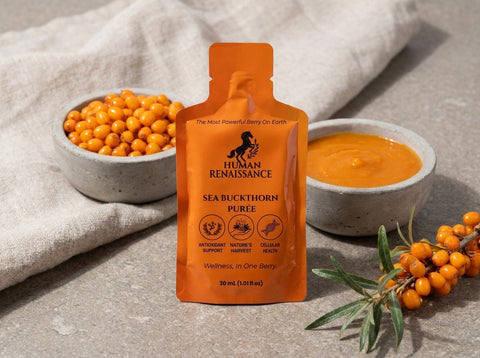
Human Renaissance is the only sea buckthorn puree in the world sold in a single-serve pouch. 190+ naturally occurring compounds, omega 3, 6, 7 and 9, 201 mg of vitamin C per pouch, 0 g sugar, 5,640 hand-picked berries per box.
Frequently asked questions
Is acai or sea buckthorn higher in antioxidants?
They carry different compound classes, so there is no single answer. Acai is higher in anthocyanins. Sea buckthorn is higher in vitamin C, carotenoids and tocopherols. Totalling those into one score across classes is not a meaningful composition measurement.
Why is acai never sold as fresh fruit?
The pulp degrades very quickly and the fruit is mostly seed, so it is commonly processed within 24 hours of harvest. Freezing or drying at source is the only practical way to move it, which is why every acai product you see has already been processed.
Can you eat both?
Yes. They are foods, not interchangeable products, and they carry different things. The useful question is what form each one arrives in, not which berry to pick.
Which one is more processed?
It depends on the specific product, not the berry. Both are sold as minimally processed whole forms and as heavily blended, sweetened ones. The ingredient panel tells you more than the fruit name does.
The short version
Acai is an Amazonian palm fruit, mostly seed, sold almost entirely as frozen pulp or powder, and its real strength is a high anthocyanin content in the raw pulp alongside a genuine fat and fibre fraction. Sea buckthorn is a cold-climate shrub berry, mostly pulp, sold as juice, puree, powder or oil, and its real strength is carrying high vitamin C, carotenoids, tocopherols and a rare omega-7-bearing pulp oil at the same time. Neither is a substitute for the other. Both are routinely judged on a retail product that has little to do with the raw fruit, and in both cases the ingredient panel decides more than the botany does. For more on the sea buckthorn side, see sea buckthorn nutrition facts.
0 Comments