





I remember sitting at my kitchen table three years ago, staring at a cabinet full of expensive probiotics and "gut-healing" powders, feeling utterly defeated. I was doing everything "right." I’d cut out gluten, swapped my morning latte for celery juice, and spent a fortune on supplements. Yet, I was still waking up bloated, my skin was breaking out like I was sixteen again, and that afternoon brain fog felt like a permanent cloud over my life.
It’s a frustrating cycle many of us know all too well. You treat your body like a temple, but the temple feels like it’s crumbling anyway. What I eventually learned changed my entire perspective on wellness: it wasn’t about what I was removing from my diet; it was about the fact that my gut lining—the actual physical barrier of my health—was compromised.
When your "gatekeeper" is tired, no amount of kale can fix the underlying chaos. That’s when I discovered the vibrant, tart power of sea buckthorn.
The Invisible Gatekeeper: Why Your Gut Lining Is Everything
Think of your digestive tract as a high-end security system. It’s a long tube lined with a single, delicate layer of cells. When this barrier is healthy, it acts as a smart filter. It lets the good stuff—like vitamin C, magnesium, and amino acids—pass into your bloodstream to fuel your life. At the same time, it keeps the "trash" (undigested food, toxins, and bad bacteria) locked away until they can be ushered out of the body.
The problem? Modern life is basically a wrecking ball for this thin lining. Stress, processed snacks, and even a lack of sleep can create tiny gaps in those "tight junctions." This is what experts call increased intestinal permeability, or "leaky gut."
When those gaps open, things that should never enter your bloodstream start floating around. Your immune system sees these intruders and goes into a state of high alert. This isn't just about a stomach ache; it’s a systemic fire. If you’ve been feeling sluggish or noticing weird rashes, your body is likely screaming for a structural repair, not just another "cleanse."
The Missing Link: Omega-7 and the Mucosal Connection
Most of us have heard of Omega-3s for our hearts or Omega-6s in our cooking oils. But have you heard of Omega-7? This rare fatty acid (specifically palmitoleic acid) is the secret sauce for your body’s "wet" tissues.
Your gut lining is a mucous membrane. It needs to be lubricated, supple, and resilient to do its job. While Omega-3s are great for lowering overall inflammation, Omega-7 is specifically targeted toward repairing the membranes that line our internal organs.
Sea buckthorn is one of the most potent plant sources of Omega-7 on the planet. It’s like sending a specialized construction crew directly to your gut wall. Instead of just trying to "kill the bad bacteria," you are actually fixing the house they live in.
Why Sea Buckthorn Puree Beats the Rest
I used to think a pill was a pill, but the more I looked into it, the more I realized that the form of your nutrients matters deeply. Many people reach for sea buckthorn oil capsules, which are fine, but they miss the "synergy" of the whole fruit.
When you use sea buckthorn puree, you aren't just getting the fats; you're getting the fiber, the bioflavonoids, and an incredible dose of vitamin C.
The Collagen Connection
We often think of collagen as something we put in our coffee for wrinkles, but your gut is actually one of the biggest consumers of collagen in your body. It provides the "mesh" that keeps your gut cells tight and strong. Here’s the catch: your body cannot produce or repair collagen effectively without high amounts of vitamin C.
Sea buckthorn contains significantly more vitamin C than an orange. By using Human Renaissance wild-harvested sea buckthorn puree, you’re providing the raw materials your body needs to "seal and heal" that internal barrier. It’s a holistic approach that recognizes your body doesn't work in isolation—it needs a symphony of nutrients to find its way back to balance.
What Science Says About This "Holy Fruit"
I'm naturally a bit skeptical of "superfood" claims until I see the data. Fortunately, the research on sea buckthorn (Hippophae rhamnoides) is extensive and fascinating.
One of the most compelling aspects is how it handles inflammation. Studies published in the National Institutes of Health database show that sea buckthorn can significantly reduce C-reactive protein (CRP) levels, which is a primary marker for inflammation in the body.
You can read more about the pharmacological effects of sea buckthorn in this detailed review.
Furthermore, the specific impact of Omega-7 on mucous membranes isn't just theory. Research indicates that sea buckthorn oil and fruit extracts can help regenerate the gastric mucosa—the protective lining of the stomach—making it a powerful ally for those dealing with ulcers or general digestive sensitivity. A study on the medicinal and therapeutic potential of sea buckthorn highlights its ability to protect the gastrointestinal tract from oxidative damage.
More Than Just a Gut Fix: The Ripple Effect
When you start focusing on the foundation, everything else starts to fall into place. It’s like fixing the foundation of a house; suddenly, the doors don’t creak and the windows actually close.
- The Gut-Skin Axis: Have you ever noticed that after a week of poor eating, your skin looks dull or breaks out? That’s the gut-skin connection at work. By strengthening your gut barrier, you stop inflammatory compounds from leaking out and irritating your skin. This is why many people who start a daily ritual with sea buckthorn notice a "glow" that no expensive serum could provide.
- Sustained Energy: If your gut is inflamed, your body is spending a massive amount of energy just trying to manage that "fire." Once the barrier is sealed, your body can finally use its energy for you—your work, your workouts, and your family.
- Immune Resilience: About 70% of your immune system lives in your gut. A healthy barrier means your immune cells can stop "policing" every meal and start focusing on actual threats, like seasonal bugs.
How to Make Sea Buckthorn a Part of Your Life
Because the puree is so concentrated and tart, you don't need much. Think of it as a "functional food" rather than a snack. Personally, I love the zingy taste—it feels like it’s waking up my cells.
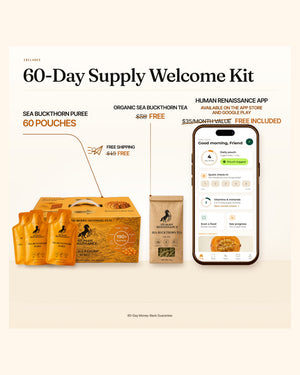
I usually start my day by stirring a tablespoon of Human Renaissance wild-harvested Sea Buckthorn puree into a glass of warm water with a little bit of ginger. It’s a gentle way to prep my digestive system before I eat anything heavy. If you aren't a fan of the tartness, it blends beautifully into a morning smoothie or can be drizzled over some full-fat yogurt.
The key is consistency. Your gut lining turns over its cells every 3 to 5 days. By giving it the right nutrients every single day, you are ensuring that each new "generation" of cells is stronger than the last.
Human Renaissance wild-harvested sea buckthorn puree
Moving Beyond "Quick Fixes"
We live in a world that loves a 3-day detox or a 24-hour "reset." But your body doesn't work on a microwave schedule. Real, lasting health is built through small, intentional choices.
If you’ve been struggling with your health, I want to encourage you to stop looking for the next "restriction" and start looking at "restoration." Are you feeding the gatekeeper? Are you giving your cells the lipids and vitamins they need to stay strong?
Healing your gut is a journey, and while it might take a little longer than a "detox tea," the results are actually sustainable. It’s about returning to biological wisdom and trusting that, given the right tools, your body knows exactly how to heal itself.
Frequently Asked Questions
Q: What does sea buckthorn puree taste like?
A: It has a very bright, citrus-like tartness. Some people compare it to a cross between a sour orange and a passionfruit. It’s definitely bold!
Q: How soon will I see results?
A: While everyone is different, many people report improvements in digestion and energy levels within 2 to 4 weeks of daily use. Skin changes usually take a full cycle of cell renewal, about 28 days.
Q: Can I take this if I have a sensitive stomach?
A: Yes, sea buckthorn is actually traditionally used to soothe the stomach lining. However, because it is acidic, we recommend starting with a small amount and mixing it with water or food.
Q: Is it safe for children?
A: Sea buckthorn is a whole food berry. However, as with any change to a child's diet, it’s always best to check with your pediatrician first.
Q: How much vitamin C is actually in it?
A: Sea buckthorn is one of the densest sources of vitamin C on Earth, containing roughly 10 to 15 times more than an orange per gram.
Q: Is it different from sea buckthorn oil?
A: Yes. The oil is extracted just from the seeds or the pulp. The puree contains the whole fruit, meaning you get the oils PLUS the fiber, vitamins, and antioxidants found in the juice and skin.
Q: Does it need to be refrigerated?
A: Yes, because it is a fresh, whole-food product with no artificial preservatives, you should keep your sea buckthorn puree in the fridge once opened to maintain its potency.


