


The mechanism
Why Do I Bruise So Easily? The Biology of a Bruise, Collagen, and Vitamin C
By Dr. Raj Dhadwal
The bruise you do not remember getting
You catch sight of a purple mark on your forearm or your shin and you have no idea where it came from. There was no fall, no hard knock, nothing you would have noticed at the time. A week later there is another one, and you start to wonder whether something is quietly wrong with you.
It is one of the most common quiet worries people carry to a search bar, and it deserves a plain answer instead of a scare. A bruise is a visible event with a straightforward mechanism, and how easily you make one depends on a handful of things that are worth understanding one at a time. This article walks through what a bruise actually is, why some people mark more readily than others, and what the published research says about the connective tissue that wraps every small blood vessel in your skin. It teaches the biology. It does not diagnose you.
What a bruise actually is
Under the skin runs a dense mesh of capillaries, the smallest blood vessels in the body, some of them barely wider than a single red blood cell. When you knock a limb, the mechanical force can rupture a few of these tiny vessels without breaking the skin above them. Blood escapes into the surrounding tissue, and because it has nowhere to drain, it pools and shows through as a mark. That is the whole event. The color changes you watch over the following days are your body dismantling and recycling the spilled blood: immune cells called macrophages arrive, break the red pigment down step by step, and the mark shifts through its familiar sequence before fading.
So a bruise is not damage to the skin surface at all. It is a small internal bleed, sealed under an intact roof, being cleaned up from the inside. That framing matters, because it tells you the two things that govern how easily you bruise: how fragile the little vessels are, and how much cushioning and support surrounds them.
Why some people bruise more easily than others
Plenty of ordinary factors change the threshold. Age is the biggest one. As skin ages it thins, the fat cushion beneath it shrinks, and the connective tissue that once held the small vessels snugly in place loosens, so the same bump does more visible damage. Dermatologists sometimes call the harmless age-related version on sun-exposed forearms actinic or senile purpura. Sun damage accumulated over decades makes it worse by weakening the supporting tissue further.
Medications matter too. Blood thinners, aspirin, and even common anti-inflammatory painkillers make bleeding easier to start and slower to stop. So do some supplements. Long courses of steroids thin the skin. Sex plays a role, since women tend to have thinner skin and a different fat distribution, and simple genetics set a baseline you were born with. None of that is a disease. It is the normal spread of human variation.
Underneath all of these sits one shared theme: the strength of the tissue around the vessels, and the integrity of the vessel walls themselves. That is a connective-tissue story, and connective tissue is mostly collagen.

The collagen scaffold around every capillary
Collagen is the structural protein that gives skin its firmness and holds the microscopic architecture of the dermis together, including the sleeve of tissue that supports each capillary. When that scaffold is well built, small vessels are held firmly and are harder to tear. When it is poorly built, they sit in a weaker matrix and rupture with less provocation.
Here is the part that surprises people. Your body cannot assemble strong collagen without vitamin C. Collagen fibers only gain their strength after specific amino acids in the protein chain, proline and lysine, are chemically modified by enzymes called hydroxylases. According to PubMed, a review of ascorbate biochemistry by Szarka and Lorincz in Protoplasma describes vitamin C acting as the essential cofactor that keeps the iron in prolyl hydroxylase in its working, reduced state so the enzyme can keep hydroxylating proline (DOI). Without that step, the collagen triple helix is unstable and the fiber is weak. This is textbook cell biology, not a health claim: it is simply how the assembly line runs.
What the research actually says about vitamin C and blood vessels
The clearest evidence here is old and unambiguous, and it comes from what happens at the extreme. Scurvy, the disease of severe vitamin C deficiency that once killed sailors, is in large part a collagen-failure disease. Because the collagen scaffold degrades, the small vessels become fragile, and among its earliest and most reliable signs are bleeding into the skin, bruise-like spots, and bleeding around hair follicles. According to PubMed, a clinical review in the BMJ on investigating easy bruising in an adult lists scurvy explicitly among the causes a clinician considers, alongside blood-clotting problems, platelet disorders, medication effects, and thin ageing skin (DOI).
Report it honestly, and the caveats matter as much as the finding. First, scurvy is uncommon in people eating any regular source of fruit and vegetables, so for most people easy bruising is not a vitamin C story at all. Second, showing that a severe deficiency causes fragile vessels does not show that taking extra vitamin C beyond sufficiency makes an already-healthy person bruise less. That study has not been done, and it would be wrong to imply the result. What the literature supports is narrower and cleaner: normal skin holds high concentrations of vitamin C and uses it to build collagen and support the dermis, as the Pullar, Carr, and Vissers review in Nutrients sets out (DOI). Vitamin C is necessary for the scaffold. Necessary is not the same as a promise.
| Contributor to easy bruising | What is going on | Connective-tissue link |
|---|---|---|
| Ageing and sun-exposed skin | Thinner skin, less fat cushion, looser support around vessels | Collagen and dermal scaffold decline |
| Blood thinners, aspirin, some painkillers | Bleeding starts more easily and stops more slowly | Not tissue related, a clotting effect |
| Genetics and sex | Baseline skin thickness and vessel fragility you were born with | Inherited collagen and tissue traits |
| Severe, prolonged vitamin C deficiency (scurvy) | Fragile vessels, skin and follicular bleeding, slow healing | Collagen cannot be built properly |
Where sea buckthorn enters the picture
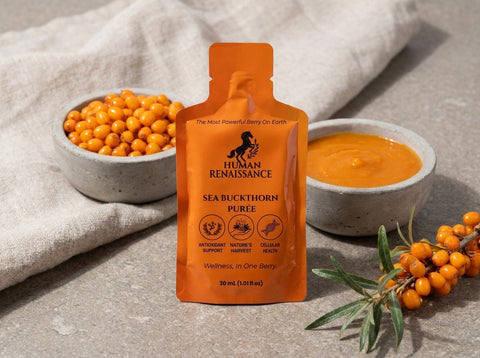
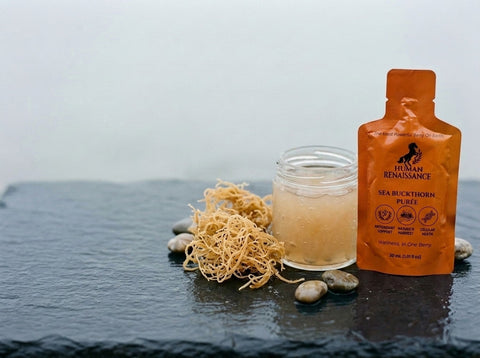
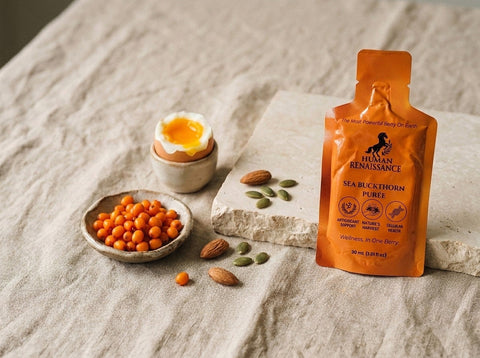
Vitamin C is one of the more studied nutrients in human biology precisely because the body cannot make it and has to be supplied it from food. Sea buckthorn is one of the foods that is genuinely dense in it. As a plain matter of composition, a single 30 mL pouch of Human Renaissance whole-berry sea buckthorn puree carries 201 mg of vitamin C, which is 223% of the Nutrient Reference Value, from one ingredient, with 0 g of sugar. That is a fact about what is in the pouch, printed on the label. It is not a statement that the pouch changes how anyone bruises, and nothing in the research above would support such a statement.
We are careful about that line on purpose. The honest position is that vitamin C is required to build collagen, that food is where you get vitamin C, and that this berry happens to be a rich food source of it. Everything past that point is your body's own chemistry doing its ordinary job.
When easy bruising is worth a doctor's visit
Most easy bruising is benign. Some is not, and it is worth knowing the difference. Bruising that appears suddenly and out of proportion, that comes with bleeding gums or frequent nosebleeds, that shows up in unusual places like the trunk, that is accompanied by fatigue or fever, or that follows a new medication, is a reason to see a clinician rather than a search engine. A doctor can check clotting, platelets, and nutrition directly. Please treat a real change in your body as a conversation with a professional, not something to solve from an article.
Common questions
Does taking vitamin C stop you bruising?
There is no good evidence that extra vitamin C reduces bruising in a person who is not deficient. What is established is that severe deficiency causes fragile vessels and easy bruising, because collagen cannot be built without it. Sufficiency matters. More than sufficiency is not shown to help.
Why do I bruise more as I get older?
Skin thins with age, the fat cushion under it shrinks, and the connective tissue supporting small vessels loosens, so the same knock does more visible damage. Accumulated sun exposure adds to it. This age-related pattern is common and usually harmless.
Is easy bruising a sign of a serious problem?
Usually not, but it can be. Sudden, widespread, or unexplained bruising, especially with other bleeding or feeling unwell, should be checked by a clinician who can test clotting and blood counts.
Is sea buckthorn a treatment for bruising?
No. It is a whole food that is naturally dense in vitamin C. This article reports the biology of collagen and the research on vitamin C, and describes what is in the pouch. It does not claim the pouch treats, prevents, or reduces bruising.
The honest close
So here is the whole of it, kept plain. A bruise is a small sealed leak from fragile capillaries, and how easily you make one comes down to the strength of the tissue around those vessels. Collagen is that tissue, and collagen cannot be assembled without vitamin C, which is why severe deficiency shows up as fragile vessels in the first place. Human Renaissance is one thing on that list of foods rich in vitamin C: whole-berry sea buckthorn puree, one ingredient, a single-serve 30 mL pouch carrying 190+ naturally occurring compounds, omega 3, 6, 7 and 9, 201 mg of vitamin C at 223% NRV and 0 g of sugar, from 5,640 hand-picked berries per box. That is composition, stated as composition, and explicitly not a demonstrated outcome for you. You can turn the pouch over, read what is in it, and decide for yourself.
This is education about biology and composition, not medical advice, and nothing here treats, cures, or prevents any condition. If you are bruising easily and it is new, widespread, or worrying you, please see a clinician who can look into it properly.
0 Comments