


The mechanism
What Actually Causes Wrinkles? Collagen, UV Light, and the Chemistry of Aging Skin
By Dr. Raj Dhadwal
The line that did not used to be there
You lean toward the mirror and there it is, a crease beside your eye that stays folded now even when your face is still. The first instinct is to reach for a cream, and the second is a vaguer question that most people never really get answered: what is a wrinkle, actually, and what put it there.
The usual answer, "you are getting older," is true and useless. It hides a specific and fairly well understood chemistry. Wrinkles are what you see when the deep scaffold of the skin loses material faster than it is replaced. Some of that loss is time, and a surprisingly large share of it is sunlight and oxidation, which are the parts you can actually reason about. This article teaches that biology plainly and then reports, as fact, what the published research has found about diet and skin aging. It does not sell you a fix. It hands you the mechanism.
What a wrinkle is, one layer down
Skin has two working layers. The thin outer epidermis is the barrier you can see and touch. Beneath it sits the dermis, a thick living mesh that gives skin its firmness, spring, and thickness. The dermis is built mostly from two proteins made by cells called fibroblasts: collagen, which provides tensile strength and structure, and elastin, which lets skin stretch and snap back. Think of collagen as the beams and elastin as the springs.
When that mesh is dense and well maintained, skin sits taut over the tissue beneath it. As collagen is lost and the fibers that remain become fragmented and disorganized, and as elastin degrades and clumps, the dermis thins and slackens. The surface no longer has a firm foundation holding it smooth, so it folds. That fold, held in place by a weakened scaffold underneath, is a wrinkle. It is a structural event in a layer you cannot see, showing up on the layer you can.
The two clocks: time, and sunlight
Skin ages on two separate schedules. The first is intrinsic aging, the slow, genetically set decline that happens everywhere on the body over decades. Fibroblasts gradually make less collagen, and the fibers already present turn over more slowly. This clock runs whether or not you ever see the sun, and it is the reason skin on a lifelong-covered area still thins with age.
The second clock is faster and it is the dominant one on your face, neck, and hands. It is photoaging, the damage done by ultraviolet light. UV does not just tan or burn. It reaches into the dermis and triggers the production of enzymes called matrix metalloproteinases, which are, quite literally, collagen-cutting enzymes. Sunlight also spends the day generating reactive oxygen species in the skin, and this is where oxidation enters the story. Those reactive molecules both damage dermal proteins directly and switch on more of the collagen-cutting machinery. The net effect is that UV-exposed skin loses and disorders its collagen far faster than shielded skin does. It is why the inside of your upper arm and the back of your hand, the same age to the day, can look decades apart.

Where collagen and vitamin C meet
Losing collagen is only half of the equation. The other half is how well the body rebuilds it, and rebuilding collagen has a hard chemical requirement: vitamin C. The strength of a collagen fiber depends on a chemical step, the hydroxylation of proline, carried out by enzymes that will not run properly without vitamin C as their cofactor. According to PubMed, a review by Boo in Antioxidants lays out this biochemical basis, describing how ascorbic acid both supports the enzymes that mature collagen and promotes collagen gene expression in dermal fibroblasts (DOI). The Pullar, Carr, and Vissers review in Nutrients makes the same point from the skin's side: normal skin holds high concentrations of vitamin C, and uses it both to stimulate collagen synthesis and as part of its antioxidant defense against UV-induced photodamage (DOI).
Read carefully, that is a statement about necessity, not a promise of youth. Vitamin C is a required input for building collagen. It does not follow that flooding the system with extra vitamin C rebuilds a face, and honest sources are explicit that the benefit of loading dietary vitamin C above sufficiency is not well established. Necessary, again, is not the same as sufficient.
What the research actually found
Two kinds of study bear on the diet-and-wrinkles question, and their limits are as important as their findings. According to PubMed, the largest is a cross-sectional analysis of 4,025 middle-aged American women by Cosgrove and colleagues in the American Journal of Clinical Nutrition, which paired dermatologists' skin assessments with dietary recall. It reported that higher vitamin C intake was associated with a lower likelihood of a wrinkled appearance (odds ratio 0.89) and of senile dryness, independent of age, sun exposure, and other factors (DOI). A separate cross-sectional study of older adults by Iizaka and colleagues in The Journal of Nutrition, Health and Aging reported that higher vitamin C intake was associated with greater measured dermal thickness (DOI).
Now the honesty. Both are cross-sectional and observational, which means they show an association at a single point in time and cannot establish that vitamin C caused the difference. People who eat more vitamin C differ in many ways from people who eat less. The Cosgrove effect size is also modest. Neither study tested a supplement or any single food, and neither used sea buckthorn. What the body of evidence supports is consistent and limited: vitamin C is biologically necessary to build collagen, and dietary patterns richer in it track with better-aging skin in population data. It stops well short of "eat this and your wrinkles go."
| What drives a wrinkle | Mechanism in the dermis | What you can reason about |
|---|---|---|
| Intrinsic aging | Fibroblasts make less collagen, turnover slows | Genetically set, runs everywhere with time |
| UV light (photoaging) | Switches on collagen-cutting enzymes (MMPs) | The dominant, most modifiable driver on the face |
| Oxidation | Reactive molecules damage fibers and boost breakdown | Generated by UV, pollution, and normal metabolism |
| Collagen rebuilding | Requires vitamin C as an enzyme cofactor | A necessary dietary input, not a proven anti-wrinkle lever |
Topical versus dietary, and why it is muddled
Most of the vitamin-C-for-skin marketing you have seen is about serums applied to the surface. The reviews are candid that the evidence for topical application, versus simply keeping dietary vitamin C sufficient, is not well resolved, and that skin gets its vitamin C from the bloodstream by way of what you eat. That is worth holding onto, because it reframes the question away from a product miracle and back toward something plainer: the skin builds its scaffold from raw materials the whole body supplies, and vitamin C is one of those materials, delivered by food.
Where sea buckthorn enters the picture
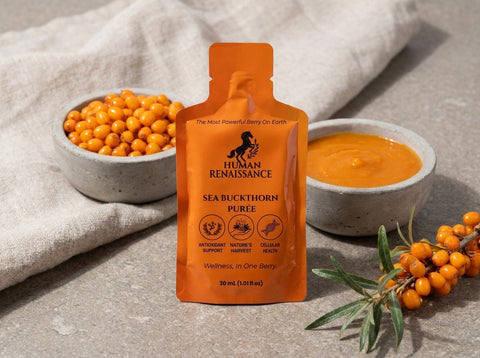
This is the one place the brand belongs in the article, and it belongs only as composition. Sea buckthorn is a food that is genuinely dense in vitamin C. As a plain label fact, a single 30 mL pouch of Human Renaissance whole-berry sea buckthorn puree carries 201 mg of vitamin C, 223% of the Nutrient Reference Value, from one ingredient, with 0 g of sugar. That describes what is in the pouch. It is not a claim that the pouch smooths wrinkles, rebuilds collagen, or slows skin aging, and none of the research above would justify saying so.
When a skin change is worth a clinician, not a mirror
Wrinkles themselves are cosmetic and normal. But skin is also where some medical signs first appear, and those are a different matter. A mole or spot that changes shape, color, or size, a sore that does not heal, or any new growth that looks unlike your other marks is a reason to see a clinician, not to read another article. When in doubt about a specific lesion, get it looked at.
Common questions
Do wrinkles come mostly from age or from the sun?
Both, on separate clocks. Intrinsic aging thins collagen slowly everywhere over decades. Photoaging from UV light is faster and dominates on exposed areas like the face and hands, because UV switches on collagen-cutting enzymes and drives oxidation.
Does eating vitamin C get rid of wrinkles?
No study shows that. Observational research links diets richer in vitamin C with a better-aging appearance, but association is not proof of cause, and vitamin C is a necessary input for building collagen rather than a demonstrated wrinkle treatment.
Is a serum better than eating vitamin C?
The evidence does not clearly settle it. Reviews note that skin draws its vitamin C from the bloodstream, that dietary sufficiency matters, and that the added benefit of topical application over diet is not well established.
Does sea buckthorn reduce wrinkles?
No. It is a whole food naturally dense in vitamin C. This article reports the biology of collagen and the research on vitamin C and skin, and states what is in the pouch. It makes no claim that the product changes wrinkles.
The honest close
Put together, the picture is clear and modest. A wrinkle is a fold that appears when the collagen scaffold beneath the skin thins and disorders faster than it is rebuilt, driven mostly by time and sunlight, with oxidation accelerating the breakdown. Rebuilding that scaffold has a non-negotiable requirement for vitamin C, and food is where vitamin C comes from. Human Renaissance is one such food: whole-berry sea buckthorn puree, one ingredient, a single-serve 30 mL pouch carrying 190+ naturally occurring compounds, omega 3, 6, 7 and 9, 201 mg of vitamin C at 223% NRV and 0 g of sugar, pressed from 5,640 hand-picked berries per box. That is composition, stated as composition, and explicitly not a demonstrated outcome for your skin. You can turn the pouch over, read what is in it, and decide for yourself.
This is education about biology and composition, not medical advice, and nothing here treats, cures, prevents, or reverses any condition, including skin aging. If a mole or skin lesion is changing or a sore is not healing, please see a clinician.
0 Comments