





Walk through the wellness aisle and almost every omega product seems to ask the same question: how much does it contain? But a growing number of shoppers are asking something more basic first: where did it come from?
Sea buckthorn puree offers a plant-pressed, whole-berry food ritual, while fish-based omega products are commonly chosen as direct sources of EPA and DHA. Different sources bring different strengths. Understanding those differences makes the label much easier to read without turning omega shopping into a competition.
This is not a story about one source being “good” and the other being “bad.” It is a story about choosing with more context.
The Omega Conversation Is Becoming an Origin Story
For years, omega shopping was mostly about capsules and numbers. Now, people are paying closer attention to taste, freshness, sourcing and how a product fits into everyday life.
That shift is one reason sea buckthorn puree is becoming interesting. It does not feel like a traditional marine-oil concentrate. It starts with a small orange berry and arrives as a tart, colourful puree that can be poured into a smoothie, stirred into yogurt or taken as a small daily shot.
I like this change in the conversation. It makes wellness feel less like memorizing a wall of nutrition labels and more like learning where your food comes from.
Where Sea Buckthorn Puree Fits Into the Omega Story
Not every omega is the same.
The NIH Office of Dietary Supplements identifies ALA, EPA and DHA as the three main omega-3 fatty acids. ALA is found in plant oils such as flaxseed, soybean and canola oil. EPA and DHA are found in fish, fish oils and krill oils, although the NIH notes that they are originally produced by microalgae at the base of the marine food chain.
Sea buckthorn puree belongs in a slightly different part of the conversation.
Research shows that different parts of the sea buckthorn berry contain different fatty-acid profiles. A study published in the Journal of Agricultural and Food Chemistry found that sea buckthorn seed oil contained linoleic acid and alpha-linolenic acid, while palmitoleic acid was found in pulp, peel and whole-berry oils. Palmitoleic acid is commonly called omega-7. Read the PubMed study on sea buckthorn berry oils.
Another PubMed-indexed study found notable levels of linoleic acid and alpha-linolenic acid in sea buckthorn seed oil. Read the sea buckthorn fatty-acid study.
This does not mean a puree pouch should be treated as a concentrated EPA and DHA product. It means sea buckthorn has its own naturally varied fatty-acid story.
For a beginner-friendly explanation of the acronyms, read Sea Buckthorn: EPA DHA ALA Omega-7 Difference.
Freshness Is About Handling, Not Fear
Freshness is one of the reasons omega products are receiving more attention.
Marine omega-3 oils can be vulnerable to oxidation. A PubMed-indexed review explains that these oils may form lipid peroxides and secondary oxidation products as they oxidize. Read the review on marine omega-3 oxidation.
The useful takeaway is not “fish oil is bad.” That would be too simple and unfair. The better takeaway is that oils should be packaged, stored and used carefully.
When comparing products, ask practical questions:
- Is each serving individually sealed or repeatedly exposed to air?
- Does the package explain how to store the product?
- Is the product easy to use consistently?
- Does the brand provide product-specific testing when a nutrient amount is stated?
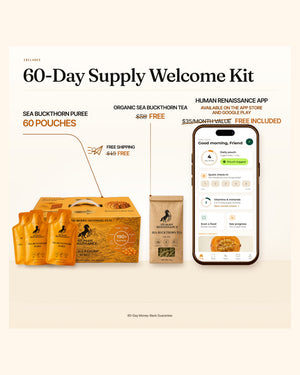
Human Renaissance wild-harvested sea buckthorn puree is packaged in individual 30 mL pouches. That format makes the daily ritual straightforward: open one pouch, use it and move on.
It is simply a different experience from opening the same bottle again and again.
Taste Is Not a Small Detail
Taste sounds less scientific than fatty-acid terminology, but it may be one of the most practical differences.
Some people enjoy fish-based omega capsules because they are familiar and convenient. Others dislike swallowing capsules or do not enjoy an ocean-associated aftertaste. Neither experience is universal.
Sea buckthorn puree has a different personality. It tastes tart, citrusy, slightly earthy and bold. Think sour orange, lemon, passionfruit and a touch of cranberry rather than a sweet breakfast juice.
My honest opinion: the first sip can be surprising. It starts making more sense when it is chilled or mixed with something familiar, such as mango, banana, yogurt, sparkling water or a little honey.
For a fuller taste breakdown, read What Does Sea Buckthorn Taste Like?.
The best omega routine is not only the one that looks impressive on paper. It is the one you will realistically keep using.
Sustainability Needs a More Honest Conversation
Plant-based and sea-caught sources are often placed on opposite sides of a debate. The reality is more nuanced.
Some shoppers prefer plant-based foods because they want a routine that does not rely on marine ingredients. Other shoppers value fish-based omega products, especially when they are looking for a direct source of EPA and DHA.
Fish oil also does not always come from a simple “catch fish only for capsules” story. The United Nations Food and Agriculture Organization reported that by-products accounted for 53% of total fish-oil production in 2022. Read the FAO State of World Fisheries and Aquaculture 2024 executive summary.
That does not settle every sustainability question. It shows why broad claims can be misleading.
Instead of asking which entire category is more sustainable, ask:
- Is the source clearly explained?
- Is the ingredient traceable?
- How is it harvested or produced?
- Does the packaging suit your routine?
- Will you realistically use the product instead of wasting it?
For someone drawn to a plant-pressed ritual, Human Renaissance wild-harvested sea buckthorn puree offers a whole-berry format with a very different origin story from a marine concentrate.
Read the Label Like a Curious Shopper
You do not need to become a biochemist. You only need a better set of questions.
Before choosing an omega product, look for these details:
- Which fatty acids are actually named? Look for ALA, EPA, DHA or palmitoleic acid rather than relying only on the word “omega.”
- What is the format? A whole-berry puree, fish-oil capsule, algae-derived oil and plant-seed oil are not interchangeable.
- Is the amount product-specific? Natural composition can vary by berry variety, plant part, processing method and batch.
- How is freshness protected? Packaging, storage and repeated exposure to air matter.
- What fits your life? Taste and consistency are part of a good routine.
Bioavailability is also worth thinking about carefully. ALA, EPA, DHA and palmitoleic acid are different molecules. A broad omega label does not make every source equivalent.
When the goal is specifically EPA or DHA, choose a source that clearly states EPA or DHA. When the goal is a plant-based whole-food ritual, sea buckthorn puree offers a different kind of experience.
Different Sources Can Share the Same Kitchen
This does not have to become a contest.
A person might eat fatty fish, add walnuts or flaxseed to breakfast and use sea buckthorn puree as a bright whole-berry ritual. Another person may choose algae-derived EPA or DHA because it suits their preferences better.
There is room for more than one thoughtful choice. The most useful question is not, “Which omega source wins?” It is, “Which source am I choosing, what does it actually provide and will it fit into my life?”
For a simple plant-pressed starting point, explore Human Renaissance wild-harvested sea buckthorn puree
Wellness, in one berry.
Human Renaissance wild-harvested sea buckthorn puree
When to Talk to a Healthcare Professional
Sea buckthorn puree is a food-form wellness product, not a treatment or a replacement for medical advice.
Speak with a qualified healthcare professional before adding a new daily food ritual if you are pregnant, breastfeeding, taking medication, managing a medical condition or considering it for a child. If you have a sensitive stomach, start with a smaller amount and see how it fits into your routine.
Frequently Asked Questions
Q: Is sea buckthorn puree the same as fish oil?
No. Sea buckthorn puree is a whole-berry plant food. Fish oil is a marine-derived oil commonly selected as a direct source of EPA and DHA. They are different products with different fatty-acid profiles.
Q: Does sea buckthorn puree contain omega-7?
Sea buckthorn pulp, peel and whole-berry oils are known for naturally containing palmitoleic acid, commonly called omega-7. The exact amount in a specific puree product should be supported by current batch testing.
Q: Can sea buckthorn puree replace fish oil?
Not automatically. If your specific goal is to add EPA and DHA, choose a product that clearly states EPA and DHA. Sea buckthorn puree is better understood as a whole-berry food with its own naturally varied fatty-acid profile.
Q: Is plant-based always more sustainable than fish-based?
Not necessarily. Sustainability depends on sourcing, traceability, production methods, packaging and waste. The FAO reports that fish-processing by-products contribute meaningfully to fish-oil production, which is one reason the comparison should stay nuanced.
Q: What does sea buckthorn puree taste like?
It tastes tart, citrusy and slightly earthy. Many people enjoy it chilled or mixed into smoothies, yogurt, sparkling water or honey water.
Sources
-
Omega-3 Fatty Acids: Fact Sheet for Health Professionals
National Institutes of Health, Office of Dietary Supplements
https://ods.od.nih.gov/factsheets/Omega3FattyAcids-HealthProfessional/ -
Fatty Acid Composition of Lipids in Sea Buckthorn Berries of Different Origins
B. Yang and H. Kallio
https://pubmed.ncbi.nlm.nih.gov/11308350/ -
Fatty Acid Composition of Developing Sea Buckthorn Berries
T. Fatima et al.
https://pubmed.ncbi.nlm.nih.gov/22558083/ -
Oxidation of Marine Omega-3 Supplements and Human Health
B.B. Albert et al.
https://pubmed.ncbi.nlm.nih.gov/23738326/ -
The State of World Fisheries and Aquaculture 2024
Food and Agriculture Organization of the United Nations
https://www.fao.org/3/cd0683en/online/sofia/2024/executive-summary.html


