





I still remember the first time I tried a traditional fish oil supplement. I was sitting at my kitchen table, trying to be "healthy," only to be met with that unmistakable, lingering fishy aftertaste ten minutes later. It wasn't exactly the glowing wellness moment I had imagined. Beyond the burps, I started thinking about where that oil actually came from—and the massive industrial scale required to pull millions of fish from the ocean just for a few capsules.
It felt like there had to be a better way to get those essential fats without the oceanic baggage. That’s when I discovered the vibrant, orange "holy fruit" of the Himalayas.
The Great Shift: Why We’re Moving Beyond the Ocean
For decades, we’ve been told that if we want heart health and glowing skin, we have to look to the sea. But in 2026, the tide is officially turning. Consumers are no longer just looking for "Omega 3"; they are looking for Omega 3 that doesn't cost the Earth.
The reality of our oceans is becoming harder to ignore. Overfishing has strained marine ecosystems to their breaking point. When we bypass the fish and go straight to the plant source, we aren't just saving the fish; we’re getting a cleaner, more complex nutrient profile. This is where the "Plant-Based Renaissance" comes in. We are realizing that plants like sea buckthorn don’t just mimic the benefits of fish oil—they often surpass them because of their unique chemical synergy.
Why Sea Buckthorn Puree Is the Ultimate Omega Upgrade
If you’ve only ever heard of sea buckthorn in high-end skincare, you’re missing out on the most potent part of the plant. While many people take isolated oil capsules, sea buckthorn puree offers the "whole food" advantage.
Unlike refined oils, a high-quality sea buckthorn puree contains the fiber, the vitamin C, and the full spectrum of fatty acids found in the fruit’s pulp and skin. It’s a bit like the difference between taking a Vitamin C tablet and eating a fresh, sun-ripened orange. The body just knows what to do with the whole food version.
A Rare Full House: Omegas 3, 6, 7, and 9
Most supplements give you one or two Omegas. Sea buckthorn is one of the only plants on the planet to provide all four:
- Omega 3 (Alpha-Linolenic Acid): The essential anti-inflammatory workhorse.
- Omega 6: Vital for brain function and muscle growth.
- Omega 7 (Palmitoleic Acid): The "beauty omega" that is incredibly rare in the plant kingdom but abundant in sea buckthorn.
- Omega 9: Supports heart health and steady blood sugar.
When I started adding a spoonful of Human Renaissance wild-harvested sea buckthorn puree to my morning smoothies, I noticed my skin felt less "tight" during the dry winter months. It’s that rare Omega 7 that really does the heavy lifting for your mucous membranes and skin hydration.
What the Science Says
We don't just have to take the word of ancient Himalayan traditions (though they’ve used this berry for centuries). Modern science is catching up fast.
A fascinating study published in Food & Function explored the synergistic effects of Omega 7 from sea buckthorn and Omega 3. The research found that these fatty acids work together to regulate lipid metabolism and reduce oxidative stress. You can read the full study on PubMed here.
Essentially, it’s not just about having Omega 3; it’s about how that Omega 3 interacts with other "helper" fats to protect your heart and liver.
Another comprehensive review in PMC highlighted how sea buckthorn metabolites act as a natural therapy for digestive diseases, thanks to their anti-inflammatory and gut-regulating properties. The study points out that the bioactives in the berry—many of which are preserved in a sea buckthorn puree—help protect the intestinal lining. Dive into those findings here.
Sustainable Healing: Good for You, Better for the Planet
One of the things I love most about sea buckthorn is its resilience. It grows in harsh, high-altitude environments where other plants give up. It’s a "pioneer plant," meaning it actually improves the soil it grows in by fixing nitrogen.
When you choose a product like Human Renaissance wild-harvested sea buckthorn puree, you’re supporting a cycle that doesn't rely on depleting the oceans. Because these berries are wild-harvested, they haven't been touched by industrial pesticides or fertilizers. They’ve survived the elements, which makes their antioxidant profile much more robust than farm-grown alternatives.
It’s a win-win: you get a concentrated dose of health, and the planet gets a break from the industrial fishing nets.
Pro Tip: If you're looking for more ways to integrate these superfoods into your routine, check out our previous post on [Sea Buckthorn Puree for Skin: Natural Remedy for Acne, Dark Spots Uneven Tone]
How to Use Sea Buckthorn Puree in Your Daily Life
You don't need to be a gourmet chef to make this work. Because sea buckthorn puree has a tart, citrus-like flavor (think a cross between a sour orange and a cranberry), it’s incredibly versatile.
- The Morning Kickstart: Stir a tablespoon into your Greek yogurt or oatmeal.
- The Glow Smoothie: Blend it with mango, ginger, and coconut water.
- The Salad Zest: Use it as a base for a vinaigrette instead of lemon juice.
I’ve found that consistency is key. Taking it daily is far more effective than an occasional "mega-dose." I personally love the ritual of it—the bright orange color alone is enough to wake up my brain in the morning.
Common Questions (FAQ)
Is sea buckthorn better than fish oil?
While fish oil is a direct source of EPA and DHA, sea buckthorn provides ALA (Omega 3) plus the rare Omega 7 and a host of antioxidants (like Vitamin C and E) that fish oil lacks. For those looking for a sustainable, vegan-friendly, and "whole-food" approach, sea buckthorn is an excellent choice.
What does sea buckthorn puree taste like?
It is very tart and acidic, similar to a very sour orange or a passionfruit. It’s best enjoyed when mixed with other foods or slightly sweetened with honey or maple syrup.
Can I take sea buckthorn every day?
Yes! In fact, most studies on its benefits for skin and heart health involve daily consumption. However, as with any supplement, it’s always a good idea to check with your doctor if you’re on specific medications, especially blood thinners.
Why choose wild-harvested over farm-grown?
Wild-harvested berries, like those used in Human Renaissance wild-harvested sea buckthorn puree, grow in extreme conditions. This stress causes the plant to produce higher concentrations of protective antioxidants and phytonutrients compared to plants grown in "easy" commercial environments.
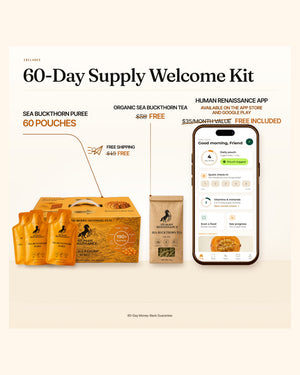
Human Renaissance wild-harvested sea buckthorn puree
The move toward plant-based omegas isn't just a fleeting trend; it’s a necessary evolution. By choosing nutrient-dense, sustainable options like sea buckthorn puree, we're taking care of our bodies and our home at the same time. It feels good to know that the secret to health isn't hidden at the bottom of a depleted ocean, but hanging from a resilient orange branch high in the mountains.


