


The mechanism
Why "Antioxidant" Is a Chemistry Word, Not a Health Promise
A practical guide to antioxidant labels, assay scores and human research, with the sea buckthorn juice study reported alongside its unchanged measurements.
By Dr. Raj Dhadwal
You are reading a food label and trying to make a sensible choice. One product says "rich in antioxidants". Another has an impressive laboratory score. A third says its ingredients have been studied. All three seem to be telling you the same thing: this will do something good for you. But the words have quietly skipped over the question you actually need answered. What was measured, and what does that measurement establish?
The word antioxidant has a real scientific meaning. The confusion begins when a description of a chemical reaction becomes a promise about a person. A good explanation should help you follow the evidence between those two places, without asking you to take the missing steps on trust.
This article is about reading that evidence. For the basic vocabulary, start with what antioxidant actually means. Here, we will look at the labels, laboratory scores and research headlines that make the word seem more conclusive than it is.
What does the word actually tell you?
An antioxidant can slow an oxidation process under the conditions in which it is tested. One route involves donating an electron; another involves transferring a hydrogen atom. The details depend on the molecules and the reaction. It is more accurate to talk about antioxidant activity in a particular setting than to imagine every antioxidant doing one identical job everywhere.
That difference is visible in the methods researchers use. The original FRAP assay measures the reduction of an iron-containing reagent, detected through a colour change. The improved fluorescein ORAC assay examines a different reaction involving peroxyl radicals and a hydrogen-atom-transfer mechanism. Both are described as antioxidant assays, but they ask different chemical questions. Benzie and Strain, 1996, Ou et al., 2001
So when someone calls a substance an antioxidant, a reasonable next question is: antioxidant against what, measured how? That is not splitting hairs. It is how you find out what the word is doing in the sentence.
Why a bigger laboratory number is not a health ranking
An assay is a test performed under specified conditions. It may follow a change in colour, fluorescence or another measurable signal. Its usefulness comes from controlling those conditions so that researchers can compare samples in a meaningful way.
In the ABTS method described by Re and colleagues, the test begins with a prepared radical and measures the change when an antioxidant sample is added. The authors specifically account for concentration and reaction time. They also explain that the improved method's results are not always directly comparable with those from the earlier version. Re et al., 1999
That should change how you read a colourful ranking of "the strongest antioxidants". Were the foods tested using the same method? Were equal amounts compared? Was the sample fresh fruit, a dry powder or a concentrated extract? If those details are missing, the ranking has lost the information that makes its numbers interpretable.
A score can be accurate and still answer a narrower question than the headline suggests. It can tell you how the tested sample behaved in that chemical system. It does not, by itself, tell you what will happen when you eat a serving, or whether the difference between two scores matters in daily life.
This is also why an impressive ratio can be misleading. Comparing a gram of dried material with a gram of fresh fruit changes the amount of water in the comparison. Comparing different assay results changes the experiment. Before deciding which number is larger, check whether the numbers belong on the same scale.

Even a blood result needs an explanation
You might reasonably think that measuring antioxidant capacity in blood settles the issue. At least the study has moved beyond a beaker of fruit extract. But the name of a blood measurement still does not tell you what caused it to change.
Lotito and Frei tested this directly in a small human experiment. Six participants consumed apples, a comparison meal, and a fructose drink under different study conditions. After the apples, plasma antioxidant capacity rose temporarily. The researchers found that much of the change was explained by a rise in urate, a compound produced during metabolism. The fructose drink reproduced that pattern. The result could not simply be attributed to apple flavonoids circulating as antioxidants. Lotito and Frei, 2004
This is not a reason to dismiss apples. It is an example of a careful experiment doing its job. The researchers investigated what a measurement represented instead of letting its appealing name supply the explanation.
Keep that distinction when you see a headline about "higher antioxidant levels". Which levels? A named nutrient? A metabolite? The combined response of a blood sample in an assay? Those observations are related, but they are not interchangeable.
What happened in the sea buckthorn juice study?
Sea buckthorn belongs in this conversation because researchers have tested its composition and investigated it in people. The useful approach is to name the preparation and keep every result attached to the study that produced it.
Eccleston and colleagues studied 20 healthy men given sea buckthorn juice or placebo for eight weeks. They reported a moderate decrease in how readily LDL particles underwent oxidation in a laboratory test. They found no significant between-group changes in total cholesterol, LDL cholesterol, platelet aggregation or the measured cell-adhesion marker. The study used juice, a different preparation from whole-berry puree. Eccleston et al., 2002
That is a more informative account than "sea buckthorn is proven to work". It tells you what was studied, how long the experiment lasted, what changed and what did not. The oxidation test was a laboratory endpoint. The study does not turn the general word antioxidant into a promise about how a food will make someone feel.
| Evidence | What it establishes | What still needs evidence |
|---|---|---|
| Food sample in an assay | Behaviour in that test system | A result after someone eats it |
| Blood measurement after a meal | The measured change at sampled times | Its cause and practical significance |
| Controlled human trial | Results for its preparation and endpoints | A different product or broader promise |
What the headline leaves out
The shortest way to evaluate a research claim is to find four things: the material, the comparison, the measurement and the result.
The material matters because juice, oil, whole berries and isolated extracts are different preparations. The comparison matters because a change from someone's starting value is not automatically an effect of the food. The measurement matters because a chemistry test, a blood concentration and a person's reported experience answer different questions. The result matters because the unchanged measurements deserve a place beside the changed ones.
Imagine a product page says, "Research shows powerful antioxidant activity." You open the citation and find a fruit extract added to a chemical reagent. The citation supports an assay finding. If the page then promises a daily benefit, the missing evidence belongs to that second sentence. Adding the word "research" does not supply it.
Or imagine a trial measures several things, finds a difference in one, and the headline presents a sweeping conclusion. You do not have to reject the finding. Keep it the size it actually is. A specific result is useful enough without stretching it into an answer to an untested question.
Does this make antioxidant research unimportant?
No. An assay helps scientists investigate a reaction. A composition study identifies what a berry contains. A metabolism study follows compounds after eating. A human trial examines selected outcomes under a defined set of conditions. Each has a job.
The trouble comes from asking one kind of experiment to stand in for all the others. A laboratory result can provide a reason for further research. It is not the completed research programme in miniature.
There is no need to turn ordinary food choices into a competition between assay scores. If your question is what a food contains, look for a clear ingredient list and composition information. If your question is whether it delivers a particular result, look for research that actually tested that result in people using the relevant preparation.
The same reading habit applies to berries, tea, cocoa and any other food described with the word antioxidant. The word can begin a useful explanation. It cannot finish one on its own.
Questions worth asking before you believe the label
Is "antioxidant" just a marketing word?
It is a scientific term that marketing often uses without enough context. Antioxidant activity can be measured. The missing detail is usually the test, the sample or the leap from the measurement to the advertised benefit.
Does a high ORAC score tell me how much I will absorb?
No. ORAC is a laboratory assay of antioxidant capacity. The fluorescein method examines a defined reaction. It does not measure a person's digestion or absorption. Ou et al., 2001
If a study finds no significant change, does that prove there is no effect?
It means that study did not establish a statistically significant change in that measurement under its conditions. It is not a licence to claim a benefit, and it is not proof that every possible effect has been ruled out. Report the result as it stands.
Can research on sea buckthorn juice support a claim for puree?
A juice study is evidence about the juice preparation and the outcomes tested. It does not automatically establish the same result for a different finished food. Shared plant origin is useful context, but the form and the actual research still matter.
What is the most useful question to ask?
"What did they actually measure?" It moves you from a broad word to a specific finding. Then check whether the sentence on the product page describes that finding or promises something beyond it.
Where the berry fits
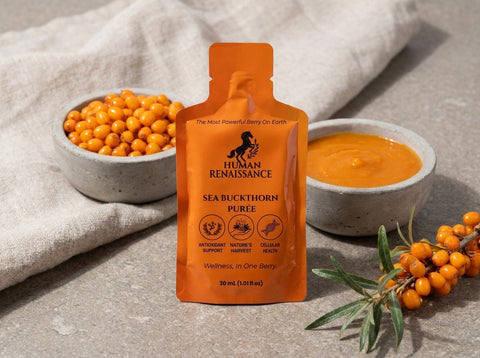
Human Renaissance makes whole-berry sea buckthorn puree in single-serve pouches: 190+ naturally occurring compounds, omega 3, 6, 7 and 9, 201 mg of vitamin C per pouch (223% NRV), 0 g sugar, 5,640 hand-picked berries per box. Those are composition facts, not a demonstrated outcome, and reading them asks nothing on trust: the ingredient list is one line long.
That is the quiet advantage of a whole food. You do not have to weigh an assay score against a headline or take a leap from a beaker to your breakfast. You can turn the pouch over, read what is in it, and decide for yourself.
This is education about food science and chemistry, not medical advice. Nothing here describes treating, curing or preventing any condition.
0 Comments