




The best source of vitamin C isn't an orange.
Oranges are the default answer. They're nowhere near the best. Here's the honest ranking of where vitamin C actually comes from — and the berry that towers over all of it.
That's roughly 7–8× less.
The orange myth
We were taught the wrong fruit
Somewhere along the way, "vitamin C" became shorthand for "orange juice." It stuck — but the orange is a middling source at best. Bell peppers beat it. Kiwis beat it. Strawberries beat it. And a small orange berry from the mountains carries several times more than any of them.12
The orange: famous, not exceptional
At ~53 mg per 100 g, one orange roughly covers a day's vitamin C — useful, but unremarkable. It earned its reputation through marketing and availability, not because it's the richest thing on the shelf.2
The ranking
Vitamin C, by food — the honest chart
Milligrams of vitamin C per 100 g
Approximate values · USDA FoodData Central and peer-reviewed analyses
A couple of obscure tropical fruits — acerola and camu camu — test even higher, but you won't find them fresh at a Canadian or US grocer, and they're far too sour to eat by the handful. Among foods you can actually buy and enjoy, sea buckthorn leads.1
One serving
A single serving, several days of vitamin C
Well past your daily target — in one go
The recommended daily intake of vitamin C sits around 75–90 mg.3 At roughly 400 mg per 100 g, sea buckthorn clears that several times over. You're not topping up — you're filling the tank, with room to spare for the days you forget.
Why it matters
What vitamin C actually does
Immune support
Contributes to the normal function of the immune system — one of vitamin C's best-established roles.
Collagen and skin
Required for the body to synthesise collagen — the structural protein behind firm, resilient skin.
Antioxidant defense
Helps protect cells from oxidative stress caused by everyday free-radical exposure.
Iron absorption
Improves how well your body absorbs plant-based (non-heme) iron from the same meal.
These are physiological roles backed by major nutrition authorities — not health cures. Vitamin C supports these systems; it doesn't treat disease.3
Beyond the number
It's not just milligrams — it's the company it keeps
Whole food beats a single isolated nutrient
A vitamin C tablet gives you vitamin C and nothing else. A whole berry delivers it alongside the antioxidants, carotenoids and fatty acids it naturally travels with — the way your body evolved to take it in. Sea buckthorn is unusual because that "company" is exceptionally rich:
The everyday way to get it
Skip the supplement aisle
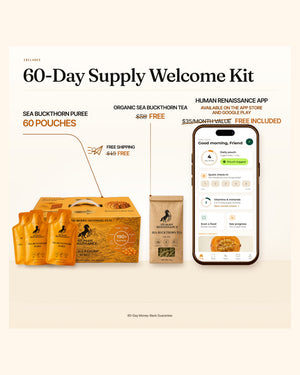
You don't need a synthetic tablet or a pile of oranges. A cold-pressed sea buckthorn purée keeps the vitamin C and its cofactors intact in a single daily pouch — the whole berry, nothing stripped out.
Human Renaissance Sea Buckthorn Purée
One wild berry, cold-pressed into single-serve pouches — high vitamin C with the omega-7, vitamin E and antioxidants it naturally comes with. 60 pouches = a 2-month supply, free shipping to Canada and the US, 60-day guarantee.
Shop the purée →
FAQ
Common questions
What food has the most vitamin C?
Among everyday foods you can actually buy, sea buckthorn leads at roughly 400 mg per 100 g — far above oranges (~53 mg), kiwi (~93 mg) or red pepper (~128 mg). A few rare tropical fruits like camu camu test higher but aren't sold fresh.12
Is sea buckthorn higher in vitamin C than oranges?
Considerably — about 7–8 times more by weight. It's one of the richest accessible plant sources of vitamin C.1
How much vitamin C do I need a day?
Most adults need around 75–90 mg daily. A serving of sea buckthorn provides several times that amount.3
Is whole-food vitamin C better than a tablet?
Whole foods deliver vitamin C alongside the antioxidants and other compounds it naturally occurs with, which a single-ingredient tablet can't replicate.4
References
Sources
- "Phytochemistry, health benefits, and food applications of sea buckthorn: a comprehensive review." Frontiers in Nutrition, 2022. frontiersin.org
- Vitamin C content of common foods (oranges, strawberries, broccoli, kiwi, peppers). USDA FoodData Central. fdc.nal.usda.gov
- "Vitamin C — Fact Sheet for Health Professionals." NIH Office of Dietary Supplements. ods.od.nih.gov
- "Wide Spectrum of Active Compounds in Sea Buckthorn (Hippophae rhamnoides)." NIH / PMC. pmc.ncbi.nlm.nih.gov
This article is for general information and is not medical advice. Sea buckthorn is a nutrient-dense whole food, not a treatment for any disease. Vitamin C values are approximate and vary by variety, ripeness and growing region.


